Best Greyhound Betting Sites – Bet on Greyhounds in 2026
Loading...
Every Track Tells a Different Story
A dog that dominates at Romford can struggle at Nottingham — and it’s not the dog that changed. The track did. UK greyhound circuits vary in circumference, bend tightness, run-up distance, and surface composition. Those differences directly affect which running styles prosper and which are neutralised, and a punter who ignores them is making selections with incomplete information.
Horse racing bettors understand this instinctively. Nobody would assess a sprinter on its Ascot form and then back it at Epsom without considering how the undulating track and left-hand bend change the challenge. Greyhound tracks demand the same awareness, yet many punters treat every circuit as interchangeable — a sand oval is a sand oval. It isn’t. The distance from the traps to the first bend varies from roughly 30 metres to over 100 metres depending on the circuit and the race distance. The bends themselves range from tight, sharp turns that punish wide runners to sweeping curves where outside dogs can maintain momentum. Some tracks drain quickly after rain; others hold water and become heavy within hours.
This guide covers the structural features of UK greyhound tracks, the difference between BAGS and evening racing, and a circuit-by-circuit breakdown that highlights the characteristics punters need to know. If you’re going to specialise — and you should — this is the information that tells you what you’re specialising in.
How UK Greyhound Tracks Are Structured
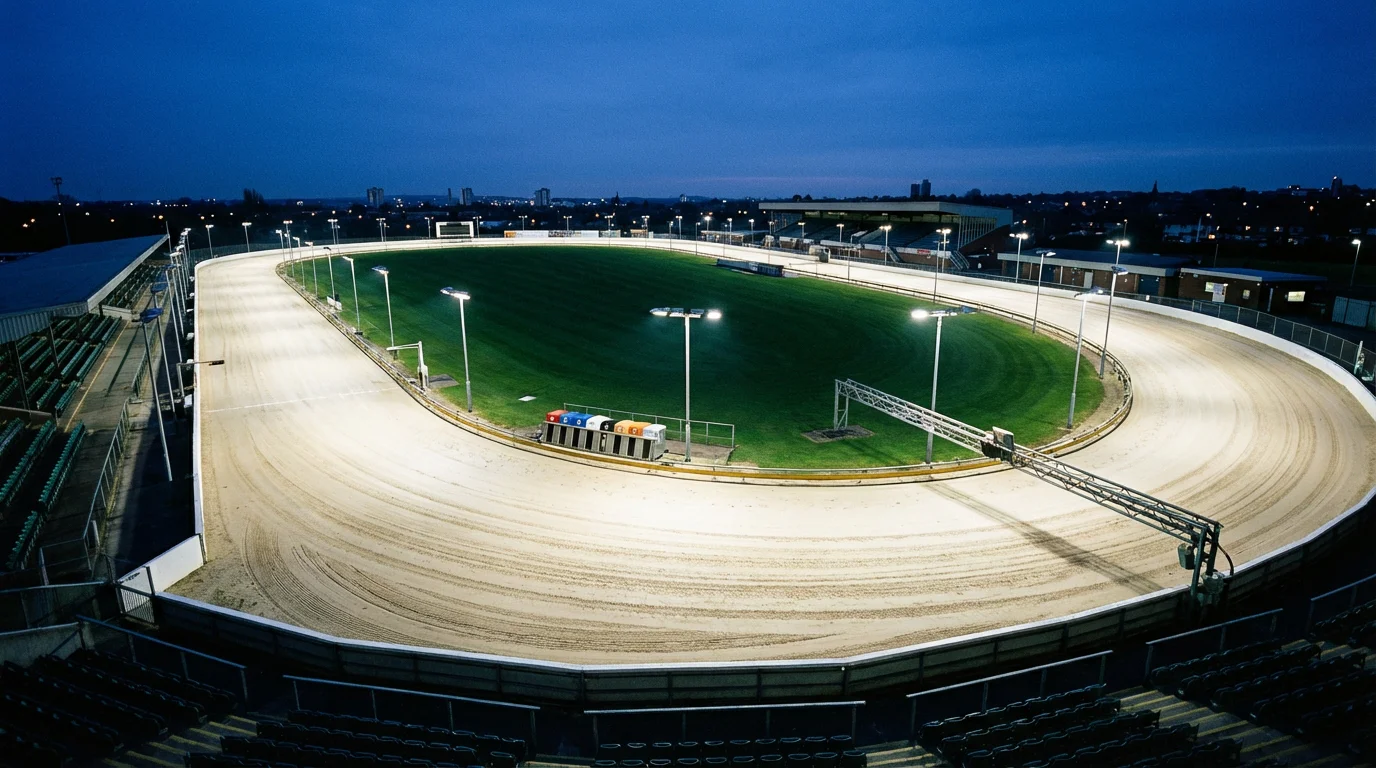
All UK tracks are ovals, but the similarities end there. Every licensed greyhound circuit is a closed loop with two straight sections connected by four bends, and the dogs chase a mechanical hare that runs on a rail around the outside (or inside, at a few older tracks). Beyond that shared template, the variation is significant.
Circumference is the starting point. Smaller circuits like Crayford and Romford measure around 380–400 metres per lap. Larger tracks like Nottingham and Towcester stretch to 480 metres or more. The circuit size affects race dynamics because it determines bend geometry. On a small circuit, the bends are tighter — the radius of curvature is smaller, which means dogs carry more centrifugal force through the turns and inside rail position becomes more valuable. On a larger circuit, the bends are more sweeping, giving outside runners more room to maintain their speed and making overtaking around the turn more feasible.
The run-up distance — the straight stretch from the traps to the first bend — is one of the most important variables. A short run-up of 30–40 metres compresses the field quickly. Dogs have less time to sort themselves into running positions, and first-bend crowding is more likely. A longer run-up of 80–100 metres gives the field more room to fan out, reduces interference, and benefits dogs with strong early pace that need a few strides to reach full speed. When you see a dog described as a “slow beginner” that still wins races, check the run-up distance at the tracks it wins at. Odds are, those circuits give it enough room to build into the race.
Surface composition is sand at every UK track, but sand quality and drainage vary. Some circuits maintain a consistent moisture level and produce reliable times across conditions. Others are more exposed to weather and produce notably different going depending on the day. Punters who track finishing times at a venue will notice that average times shift after heavy rain and take a meeting or two to return to normal — information that the racecard alone doesn’t highlight.
Standard distances offered at each track depend on the circuit size and the position of the starting traps relative to the first bend. A track might offer 265m (sprint), 480m (standard), and 680m (marathon), with each distance starting from a different trap position along the straight. Knowing which distances are available at which tracks matters because a dog entered at an unfamiliar distance at a new venue is facing two unknowns simultaneously — and two unknowns rarely produce a reliable selection.
BAGS Tracks vs Evening and Feature Meetings
BAGS racing is the bread and butter — but the evening cards bring the quality. Understanding the distinction shapes both how you select races and where you look for betting value.
BAGS stands for Bookmakers’ Afternoon Greyhound Service, a programme of daytime meetings broadcast into betting shops and streamed online through platforms like SIS. BAGS meetings run throughout the day, from late morning into the afternoon, at tracks across the country. They provide the fixtures that keep betting shop screens occupied and off-course bookmakers supplied with racing content. The grading at BAGS meetings tends to be mid-range to lower — A5 through A8 or equivalent — because the premium dogs are typically reserved for evening and feature cards. The fields are competitive but rarely elite, and the form can be inconsistent because dogs at these grades are more prone to runs of erratic results.
Evening meetings are a step up. Held from around 7pm onwards, these cards attract better dogs, higher grading, and often stronger entries from leading trainers who target the more prestigious slots. Evening racing also draws more public attention — larger on-course crowds, more betting activity, and better media coverage. The grading ranges from A1 to A4 at the top tracks, with supporting races at mid-grade levels. The quality difference matters for betting: form lines at evening meetings tend to be more reliable because the dogs are more consistent, the standard of competition is more uniform, and the results are less susceptible to random interference outcomes.
Feature meetings sit above both. These are the named competitions — category races, open events, and invitational fixtures — where the strongest dogs at a venue compete for enhanced prize money. Feature races are open class, meaning there’s no grading restriction and any dog can be entered. The form reading for these races is more demanding because you’re comparing dogs across different grades and sometimes different tracks, but the markets are also more liquid and the bookmaker pricing tends to be sharper.
For the punter, the choice between BAGS and evening racing is partly about availability and partly about strategic preference. BAGS meetings offer more races per day, more betting opportunities, and thinner markets where a knowledgeable punter can occasionally find bookmaker prices that haven’t been fully adjusted. Evening meetings offer better quality, more predictable form, and larger betting pools that produce more stable market pricing. Neither is inherently better — but the analytical approach should differ. BAGS racing rewards spotting class drops, kennel form, and trainer patterns at specific tracks. Evening racing rewards deeper form study and sharper price awareness in more competitive markets.
Track-by-Track Profiles
Here’s what you need to know about every major active circuit. These profiles focus on the characteristics that directly affect betting decisions: circuit size, bend tightness, key distances, and the running styles that tend to prosper at each venue.
London and South East Tracks
Romford is the sole remaining London track following Crayford’s closure in early 2025, and among the most frequently bet-on circuits in the country. The circumference is approximately 350 metres, making it a compact, tight-turning oval. The standard distance is 400m over four bends, with sprints at 225m and longer trips at 575m. The bends are sharp, and the run to the first bend is short — factors that heavily favour railers and fast breakers. Trap 1 carries a pronounced statistical advantage here, particularly at sprint distances. Overtaking is difficult once the first bend is settled, so identifying the likely leader is the primary analytical task. Romford hosts regular BAGS and evening cards, and the track’s consistent surface tends to produce reliable times that make form comparison straightforward.
Crayford was the other London circuit and shared some of Romford’s characteristics — compact, tight bends, rail-biased — but with its own nuances. The circumference was around 334 metres, and the standard distances were 380m and 540m. The run-up was short, amplifying the importance of trap speed. Crayford produced competitive lower-to-mid grade racing and was a BAGS staple. Form at Crayford was generally reliable because the surface was well maintained and conditions were relatively sheltered. Crayford closed permanently on 19 January 2025 following Entain’s decision to cease operations at the venue.
Henlow in Bedfordshire raced over 277m, 460m and 660m on a circuit of about 410 metres. It was a slightly more galloping track than the London pair, with more forgiving bends that gave outside runners a better chance. Trap bias was less pronounced here than at Romford or Crayford. Henlow closed permanently on 21 January 2024 after the court ruled against the owners renewing their lease, with plans approved to build homes on the site.
Central Park, based in Sittingbourne, Kent, offers a compact circuit with distances including 265m, 480m and 630m. It’s a well-established BAGS venue with a loyal following. The bends are moderate in tightness, and early pace is important but not as dominant as at the tightest London circuits.
Midlands and Northern Tracks
Nottingham is the outstanding galloping track in the UK. The circumference is 437 metres, and the bends are wide and sweeping — the closest thing greyhound racing has to a flat, fast horse racing course. Standard distances include 305m, 480m, 500m and 700m. The generous run-up distance gives dogs time to find their stride, and the wide bends make overtaking genuinely possible at every stage of the race. This is the circuit where closers and strong finishers thrive. Trap draw is less decisive here than at tighter tracks, and the key sectional to watch is the finishing split rather than the first-bend time. Nottingham hosts evening racing of a high standard and some of the best open-class competitions outside the Derby.
Monmore Green in Wolverhampton races over 264m, 480m and 630m on a circuit of around 420 metres. The bends are tighter than Nottingham but less extreme than Romford, placing it in a middle ground where both early pace and finishing speed carry weight. Monmore has a strong programme of BAGS and evening meetings and is one of the more balanced tracks in terms of trap bias — inside traps have an edge, but the margins are smaller than at the compact London circuits.
Perry Barr in Birmingham had a circumference of approximately 434 metres with a 60-metre run to the first bend. Distances included 275m, 480m, 660m, 710m and the marathon 915m. Perry Barr was known for hosting quality evening racing and category competitions, including its annual Birmingham Cup. The track’s moderate bend geometry meant form from similar-sized circuits translated reasonably well. Perry Barr closed on 23 August 2025, with its greyhound racing operation transferring to the newly built Dunstall Park Greyhound Stadium at Wolverhampton Racecourse, which opened on 19 September 2025.
Belle Vue in Manchester was historically one of the most significant greyhound venues in the country — the first purpose-built greyhound stadium in Britain, opening in 1926. It operated on a circuit of around 400 metres with distances at 260m, 470m, 645m and 835m. The run to the first bend was longer than at many comparable tracks, which gave wider-drawn dogs more time to find position. However, Belle Vue closed permanently in 2020 after the Arena Racing Company concluded there was no longer a business case to keep the stadium operating. Demolition began in 2021, and the site has since been redeveloped for housing. Greater Manchester no longer has a licensed greyhound track.
Sheffield races over 280m, 480m and 660m and features a moderate-to-wide circuit. It’s a balanced track where both pace and stamina play a role depending on the distance. Doncaster offers a similar profile, with distances at 270m, 450m and 640m on a circuit that produces fair racing for most running styles.
Sunderland is notably exposed to weather — wind across the back straight can affect finishing times, and rain arrives quickly from the North Sea. The circuit circumference is approximately 390 metres, with racing over 265m, 450m and 640m. Despite the compact layout, the longer run-up softens the extreme rail bias seen at the tightest tracks. Kinsley in West Yorkshire is one of the smaller northern circuits, racing over 277m, 462m and 650m. Newcastle at Byker operates over 285m, 480m and 640m and benefits from decent facilities following investment in recent years.
South Coast and Other Circuits
Hove, near Brighton, is one of the most established tracks in the country. The circumference is approximately 450 metres, and racing takes place over 285m, 500m, 695m and other distances up to marathon trips. The bends are moderate, and the longer straight sections mean pace dogs are tested for stamina over the standard distance. Hove hosts regular evening meetings with strong grading, and the Sussex track has a reputation for producing some of the best mid-grade racing in the south.
Towcester in Northamptonshire is the current home of the English Greyhound Derby and arguably the most high-profile circuit in the country. The track was built inside the horse racing course and features wide bends with a distinctive slight incline on the approach to the first turn. Standard distances are 260m, 480m, 500m, 655m, 686m and 906m on a 420-metre circumference circuit. The wide bends favour strong, athletic dogs that maintain speed through turns — pure railers still benefit from Trap 1, but the advantage is smaller than at Romford or Crayford. Towcester’s championship pedigree means form from this track is particularly worth tracking for ante post purposes. The going can change noticeably after rain, as the exposed Northamptonshire location makes the surface susceptible to weather.
Yarmouth operates on one of the more exposed circuits on the east coast, with wind a significant factor across the back straight. Distances include 277m, 462m and 659m. The surface is well maintained but can turn heavy quickly in sustained rain. Oxford, which returned to the racing calendar more recently, hosts both BAGS and evening meetings with a modern facility. The Valley in South Wales — the only Welsh track under GBGB licence — races over a compact circuit, though its future is uncertain after the Welsh Government introduced legislation in 2025 to ban greyhound racing in Wales.
Track Conditions: What Changes Between Cards
The same track on a dry Tuesday and a wet Friday evening is two different circuits. Surface conditions shift between meetings — sometimes between races within a meeting — and those shifts change the outcome equation in ways that the racecard’s historical form figures don’t fully capture.
The primary variable is moisture. UK greyhound tracks maintain their sand surfaces within a target moisture range, typically 8–12%, but rain and evaporation push conditions above or below that band. After heavy rainfall, moisture content can climb above 15%, and the surface becomes heavy and holding. Finishing times slow across the board, but they don’t slow evenly across all running styles. Heavier, more powerful dogs tend to cope better because they can muscle through the soft surface. Lighter, pace-dependent dogs lose the sharp acceleration that defines their running style. If your selection’s strength is blistering early speed and the track has been soaked overnight, adjust your expectations.
Drainage varies by track. Some circuits sit on well-drained foundations and recover quickly — an hour of drying can return the surface to near-normal. Others hold water for longer, and the effects of overnight rain persist well into the following card. If you specialise in a particular track, learn how it handles wet weather. After a few months of observation, you’ll develop an instinct for how much a forecast of heavy rain at that venue actually changes the racing.
Temperature matters at the margins. Hot, dry summer weather firms the surface and produces faster times. Cold winter evenings, particularly with frost, can make the sand slightly tacky. The effects are less dramatic than rain but not negligible, especially in accumulator and forecast bets where small time differences across multiple races compound into meaningful form distortions.
Going reports are published by some tracks, either on their official channels, via social media, or through form services. Where available, they’re worth checking. A going report that describes the surface as “heavy” or “testing” should immediately prompt you to reconsider any selection whose recent form was recorded on fast going. Conversely, a dog that has shown improved form on wet cards and is running tonight on a rain-affected surface may be a better proposition than its overall form figures suggest.
Wind is the overlooked variable. Tracks in exposed locations — particularly coastal and northern venues — can experience crosswinds or headwinds that add measurable time to finishing splits on the affected straight. Checking the forecast wind speed and direction for the venue is a thirty-second task that provides information most punters never bother to acquire.
Choosing Your Circuit: A Punter’s Approach
Specialise first. Browse second. The volume of racing across UK greyhound tracks can create the illusion that more races mean more opportunities. In practice, the opposite is true. More races mean more chances to bet without understanding the conditions, and uninformed bets are the foundation of bookmaker profits.
Choose your starting circuit based on two practical criteria: access and regularity. Access means being able to watch races, either through live streaming via your bookmaker, through free-to-air broadcasts on RPGTV, or — ideally — by attending the track in person. Watching races, not just reading results, is how you learn the things the racecard doesn’t tell you: how individual dogs respond to crowding, how the first bend plays out in different trap configurations, how the surface looks on different nights. Regularity means the track runs often enough for you to build a meaningful sample of observations. A circuit that hosts two or three meetings per week gives you enough data to recognise patterns within a month. A circuit that races once a fortnight will take three times as long to generate the same insight.
London punters naturally gravitate toward Romford, now the sole remaining licensed track within the M25 following Crayford’s closure in January 2025. Midlands bettors have Monmore, Nottingham, and the new Dunstall Park within range. Northern punters can build expertise at Sheffield or Sunderland. The geography matters less than the commitment: whichever track you choose, give it your full attention for at least a month before placing meaningful stakes.
Once you’ve learned one circuit, the second becomes easier. You’ll already understand the principles — trap bias, bend geometry, surface sensitivity — and you’ll be adapting existing knowledge to a new layout rather than starting from scratch. The punters who build long-term greyhound betting results are the ones who treat each track as a separate puzzle, not a uniform backdrop to a universal system. A dog’s form at Romford tells you about its ability at Romford. What it does at Nottingham is a different question, and the track profile — circumference, bends, run-up, going — is what shapes the answer.