
The Shape of the Game: How UK Greyhound Racing Works
Greyhound betting is not horse racing with smaller animals. The fields are fixed at six runners. Races last roughly thirty seconds. Cards turn over every fifteen minutes, which means a single evening at the track can offer more betting opportunities than an entire Saturday afternoon at Ascot. The form factors are different, the market dynamics are different, and the edges available to a prepared punter are different. This guide consolidates everything a UK bettor needs to approach the sport seriously: bet types, odds mechanics, form analysis, trap draw strategy, racecard interpretation and the external factors that tilt outcomes on any given night.
There are 18 licensed greyhound tracks operating in Britain under the authority of the Greyhound Board of Great Britain (GBGB), the regulatory body responsible for track licensing, animal welfare, race integrity and the grading system. Races take place almost every day of the week, split between afternoon BAGS meetings (Bookmakers' Afternoon Greyhound Service, which supplies content to betting shops and online platforms) and evening or featured cards that attract larger fields and higher-quality dogs. Information advantages compound quickly in this environment, and the punters who build those advantages are the ones taking money home.
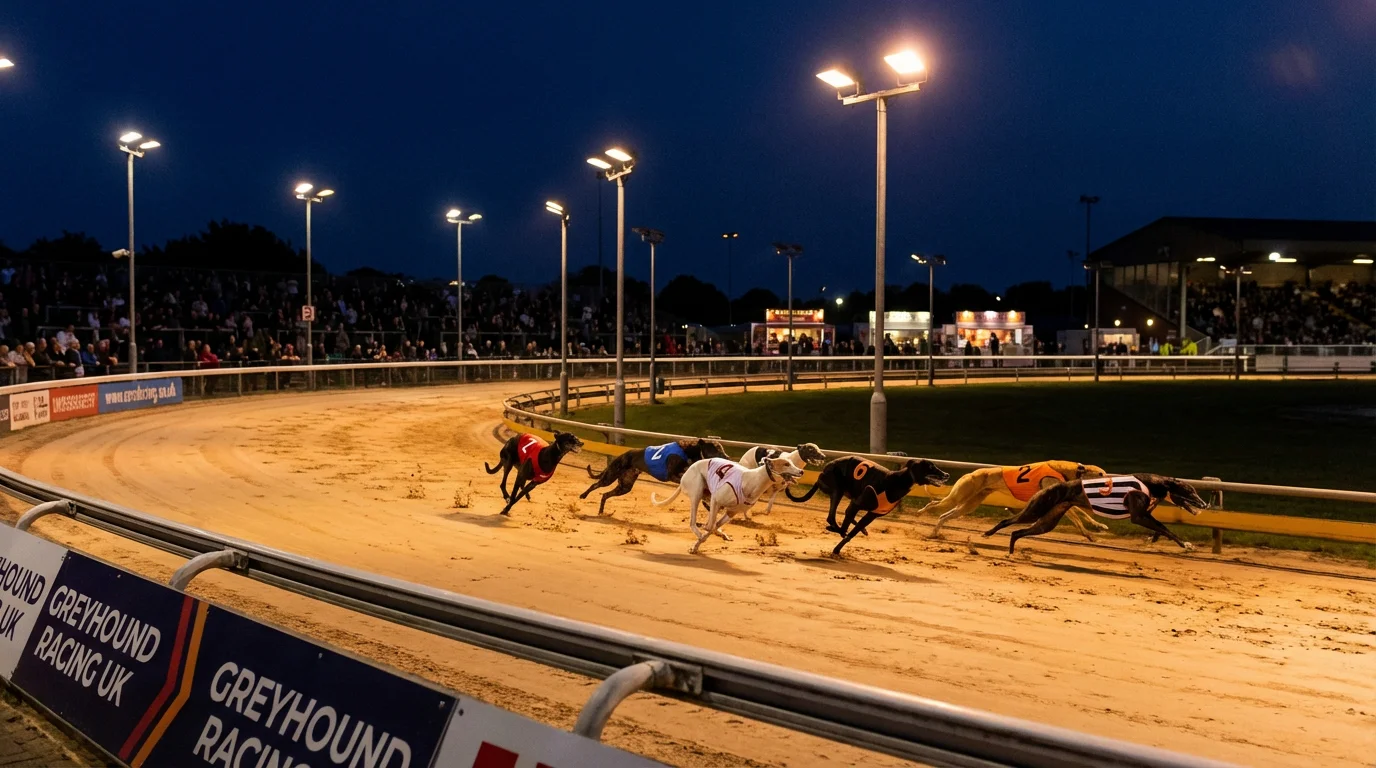
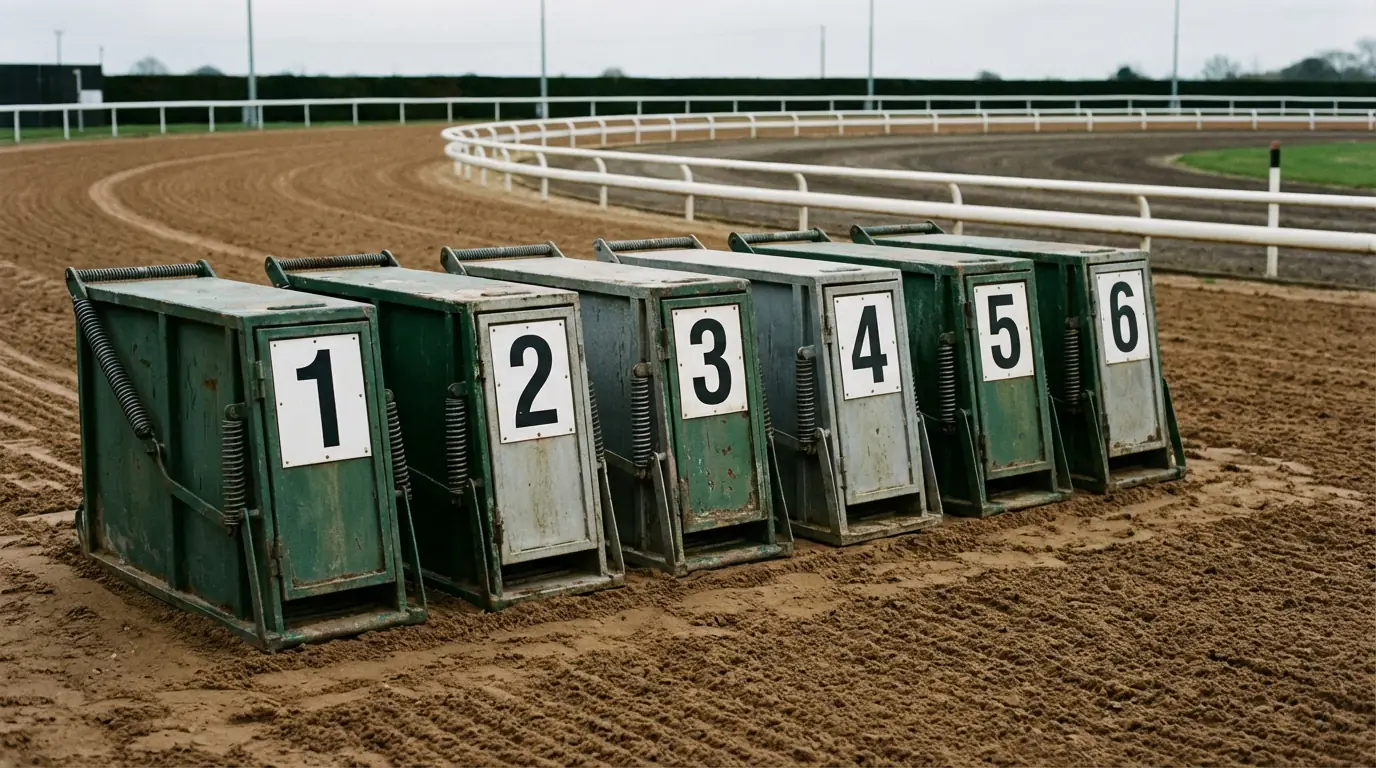
Every race follows the same basic format: six greyhounds are loaded into numbered starting traps, a mechanical hare accelerates past them, the traps spring open, and the dogs chase the hare around an oval sand track. Most tracks are roughly 400 metres in circumference, with four bends and two straights. The standard race distance is between 460 and 500 metres — four bends, start to finish. Shorter sprints and longer stayer races also feature on most cards, and the distance profile of a dog matters enormously for betting purposes.
What distinguishes greyhound racing from most other betting sports is the frequency and volume. A typical evening card at a track like Romford or Crayford contains 12 to 15 races. BAGS meetings run throughout the afternoon across multiple tracks simultaneously. For the bettor, this means constant action — but it also means the temptation to bet without preparation is ever-present. The punters who profit from greyhound racing are the ones who treat each race as a discrete analytical exercise, not as background noise for an evening out.
6 dogs per race. Around 30 seconds from traps to line. 18 licensed GBGB tracks across the UK. Greyhound racing runs almost every day, with BAGS afternoon meetings feeding betting shops and online platforms, and evening cards offering higher-grade competition. The compact field size and rapid turnover create a fundamentally different betting rhythm from horse racing.
How a Race Is Structured — Traps, Distances and Grades
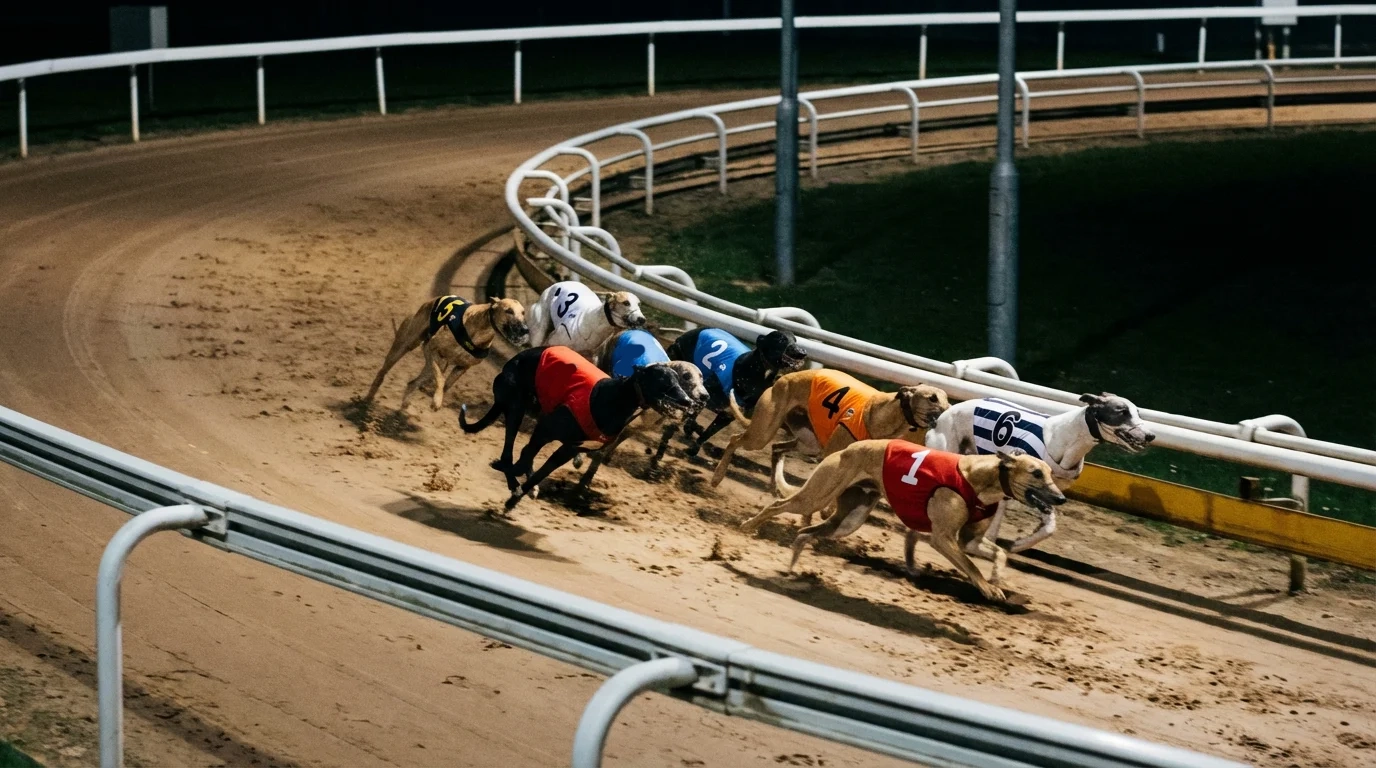
Each dog is assigned a numbered trap from 1 to 6, and each trap has a corresponding jacket colour: red for 1, blue for 2, white for 3, black for 4, orange for 5 and striped (black and white) for 6. The trap number determines the dog's starting position on the track, and because greyhound racing takes place on an oval with tight bends, starting position has a measurable effect on outcomes. Dogs drawn on the inside have a shorter path to the first bend; dogs drawn wide must cover more ground but may avoid trouble if the inside runners crowd each other.
Distances fall into three broad categories. Sprint races — typically under 400 metres — are over in two bends and reward raw pace above all else. Standard distance races, the most common, cover 460 to 500 metres over four bends and require a blend of speed and stamina. Stayer and marathon races extend beyond 600 metres, sometimes over six or even eight bends, and here the equation shifts toward endurance and tactical positioning.
The grading system sorts dogs into classes based on ability. Open class is the highest tier — the elite runners competing in feature events like the English Greyhound Derby. Below that, grades descend from A1 through to A11, depending on the track, with each step representing a band of proven ability measured primarily through finishing times and recent results. A dog's grade determines which races it enters, and when a dog moves between grades — promoted after strong performances, or dropped after poor ones — it changes the competitive context entirely. A dog dropping from A3 to A5 is not getting worse; it is about to face easier opposition, which is exactly the kind of detail that separates a winning bet from a losing one.
You know how the race works. Now here is every way you can bet on it.
Greyhound Betting Markets: Every Bet Type You Can Place
Before you study a single form line, know what you can actually bet on. Greyhound racing offers a broader range of wager types than most newcomers expect, from straightforward win bets through to combination tricasts that demand you predict the exact finishing order of the first three dogs. Each bet type suits a different situation, a different level of conviction and a different risk appetite. Understanding the full menu is the first step toward knowing when to use which option.
Win
Back a dog to finish first. The simplest bet in racing.
Each Way
Two bets: one to win, one to place in the top two. 1/4 odds on the place part.
Forecast
Predict first and second. Straight (exact order) or reverse (either order).
Tricast
Predict first, second and third. Straight or combination for all permutations.
Accumulator
Chain multiple selections across races. Each winner rolls into the next.
Ante Post
Bet on major events weeks or months before they run. Higher risk, bigger prices.
Win, Place and Each Way Bets on Greyhounds
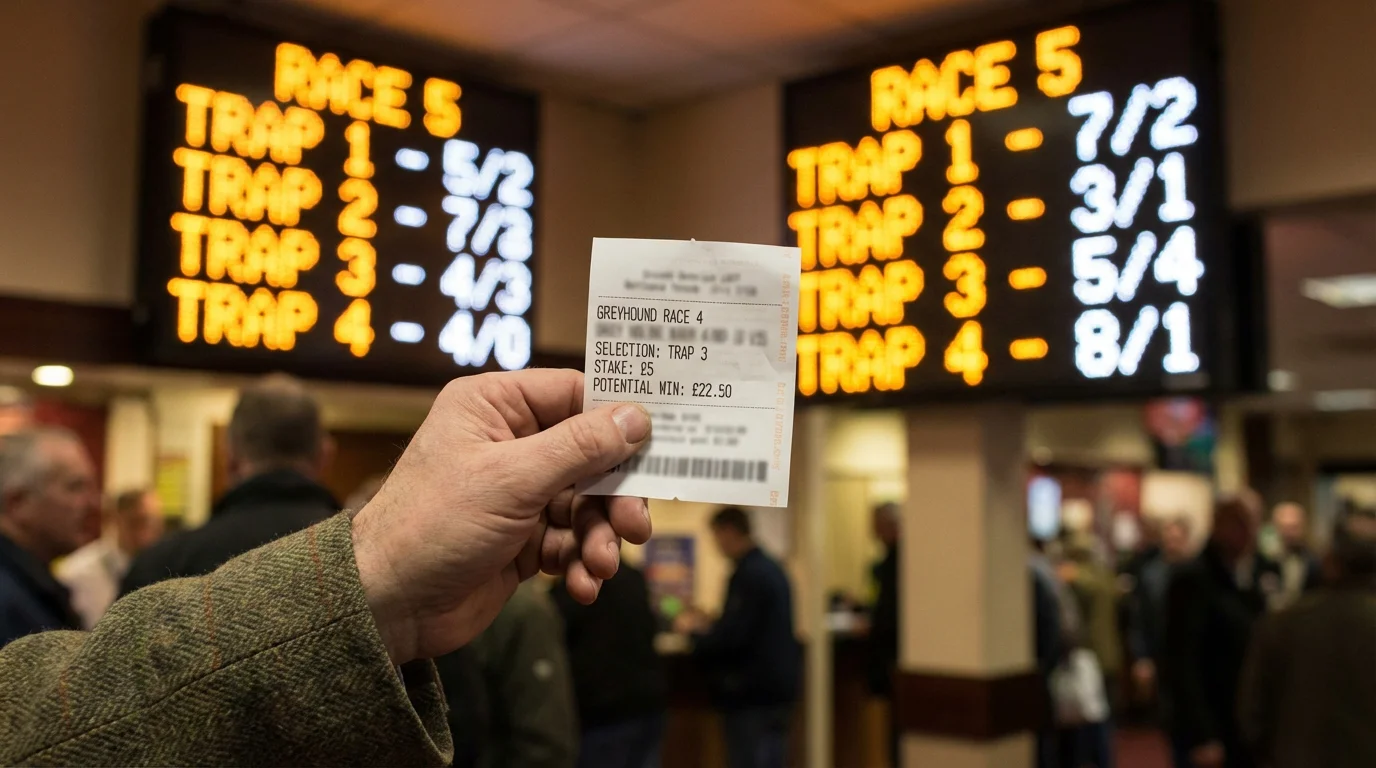
A win bet is exactly what it sounds like: you back a dog to cross the line first, and if it does, you collect at the agreed odds. If it finishes second by a short head, you lose. There is no complexity here, but the simplicity is the point — win bets force you to commit to your strongest opinion without hedging.
Place bets allow you to back a dog to finish in the top two. In greyhound racing, with only six runners, the standard place terms are top two at one quarter of the win odds. This is tighter than horse racing, where larger fields often pay three or even four places. The implication is significant: each way betting on greyhounds requires your selection to be genuinely competitive, not just capable of sneaking into the frame.
Each way is two separate bets at equal stake — one on the win, one on the place. If your dog wins, both parts pay out. If it places but does not win, only the place part returns. The mathematical threshold where each way starts to offer value over a straight win bet is around 4/1 in six-runner fields. Below that price, the place part typically does not generate enough return to justify doubling your stake. Above 4/1, particularly in races where you believe a dog will be competitive but faces one or two stronger rivals, each way becomes a legitimate hedge rather than a waste of money.
Forecast and Tricast Bets Explained
A forecast bet asks you to predict the first two finishers. A straight forecast requires you to name them in the correct order — first and second, exactly as they cross the line. The payout is calculated as a dividend, similar to tote pool betting, and can vary significantly between bookmakers. Computer straight forecast (CSF) returns are calculated using an industry formula; some bookmakers offer their own forecast prices which may be higher or lower.
A reverse forecast covers both possible orders of your two selections. If you pick Dog A and Dog B, a reverse forecast pays out whether A finishes first and B second, or B finishes first and A second. It costs twice the unit stake because it is two separate bets. Reverse forecasts are useful when you are confident about which two dogs will dominate but uncertain about the order — a common scenario in greyhound racing where two class dogs can easily swap positions depending on the first bend.
Tricast bets raise the difficulty — and the returns. A straight tricast requires you to name the first three finishers in exact order. A combination tricast covers all six possible arrangements of your three selections (3 x 2 x 1 = 6 bets at your unit stake). In a six-runner field, a combination tricast is asking you to identify half the field correctly, which is statistically far more achievable than in horse racing with its 10 to 20-runner handicaps. This is why tricast betting has a genuine strategic home in greyhound racing: the small field makes it viable rather than purely speculative.
Accumulators and Ante Post Wagers
Accumulators chain together multiple selections across different races. Each winner's returns become the stake for the next leg. A four-fold accumulator at modest individual prices can generate substantial returns, but the probability drops with every leg added. Most bookmakers offer acca insurance on greyhounds, refunding your stake as a free bet if one leg lets you down, though terms vary and typically require minimum odds per selection.
Ante post betting lets you back dogs for major events well before the competition starts. The English Greyhound Derby, the sport's premier event held at Towcester each summer, opens ante post markets months in advance. Prices are longer because the uncertainty is greater — your dog might not even make the final — but ante post bets carry risk: if your selection is withdrawn, most bookmakers will not refund your stake. The 2026 Derby, with first-round heats expected in late spring, will see ante post markets available from early in the year for punters willing to take the long view.
Understanding Greyhound Racing Odds
Odds are not predictions — they are a market. Every price attached to a greyhound reflects the bookmaker's assessment of its probability of winning, adjusted to include a profit margin. Understanding how odds work, how they are set and how they move is non-negotiable if you want to bet with any degree of seriousness.
In the UK, greyhound odds are most commonly displayed in fractional format. A dog priced at 7/2 returns seven units of profit for every two units staked, plus the stake back. At 3/1, you collect three pounds for every pound wagered. Evens (1/1) means your profit equals your stake. Odds-on prices like 4/6 mean you must risk more than you stand to gain — six pounds staked to win four in profit. Decimal odds, used more widely on betting exchanges and European platforms, express the total return including the stake: 7/2 fractional becomes 4.50 decimal, meaning a one-pound bet returns four pounds fifty in total.
The critical distinction for greyhound punters is between starting price (SP) and fixed (or early) price. The starting price is determined at the moment the traps open, based on on-course market activity. A fixed price is the odds you lock in at the moment you place your bet, regardless of subsequent market movement. In greyhound racing, where betting pools are smaller and markets thinner than horse racing, the SP can drift significantly from the morning or afternoon price. A dog might open at 3/1 and go off at 5/1 because money has piled onto a rival. If you took the 3/1 early and the SP is 5/1, you have been shortchanged — unless your bookmaker offers best odds guaranteed (BOG), which pays out at whichever price is higher.
UK Dogs Odds & Staking Toolkit
Three tools built from the guide’s own odds mechanics — book margin, track conditions, and accumulator maths.
Implied probability per runner = denominator ÷ (numerator + denominator). A fair six-runner book sums to 100%; UK greyhound books typically run 115–125%. Fair odds strip out the margin by rescaling each runner’s implied probability so the six sum to exactly 100%.
UK sand tracks typically run 8–12% moisture. The guide notes a 3% moisture rise adds roughly 0.15 seconds over 480m — this tool scales that rate linearly by distance and moisture change. Treat it as an estimate, not a lab measurement.
Combined odds multiply across legs; combined win probability multiplies too. Four dogs at 2/1 (decimal 3.0) each produce combined odds of roughly 80/1, exactly as the guide describes — but if each only has a genuine 40% chance, the true probability of landing all four is just 2.56%.
The overround — the built-in margin on a book — is the sum of implied probabilities across all runners. In a fair market, six runners would sum to 100%. In practice, a typical greyhound book sums to 115 to 125%, meaning the bookmaker has a 15 to 25% theoretical edge. Tighter books offer better value; wider books extract more margin. Comparing overrounds across bookmakers for the same race is one of the simplest ways to identify where your money goes furthest.
Trap 3 — Ballymac Doris
Odds: 7/2
Stake: 10
Calculation: (7 / 2) x 10 = 35 profit + 10 stake = 45 total return
Implied probability: 2 / (7 + 2) = 22.2%
How to Read a Greyhound Racecard
Everything you need is on one card — if you know where to look. A greyhound racecard compresses a dog's recent history, physical profile and competitive context into a few lines of data. Each entry tells you the trap number, jacket colour, dog's name, trainer, recent form figures, best times at the distance, weight and a line of race comments from previous runs. Learning to read this information efficiently is what separates the punter who studies from the punter who guesses.
The first thing to check is the trap number and the dog's seeding. Is this a railer (an inside-running dog suited to low trap numbers) drawn in trap 1 or 2, or has it been allocated an unfavourable outside position? Next, look at the form string — the sequence of finishing positions from the dog's most recent races, read left to right with the most recent run on the right.
Form string — the sequence of finishing positions from a greyhound's recent races, typically showing the last six runs. A form line of 1-3-2-4-1-2 tells you the dog won its latest race, placed second in the one before that, won two runs back, and so on. Read right to left for chronological order.
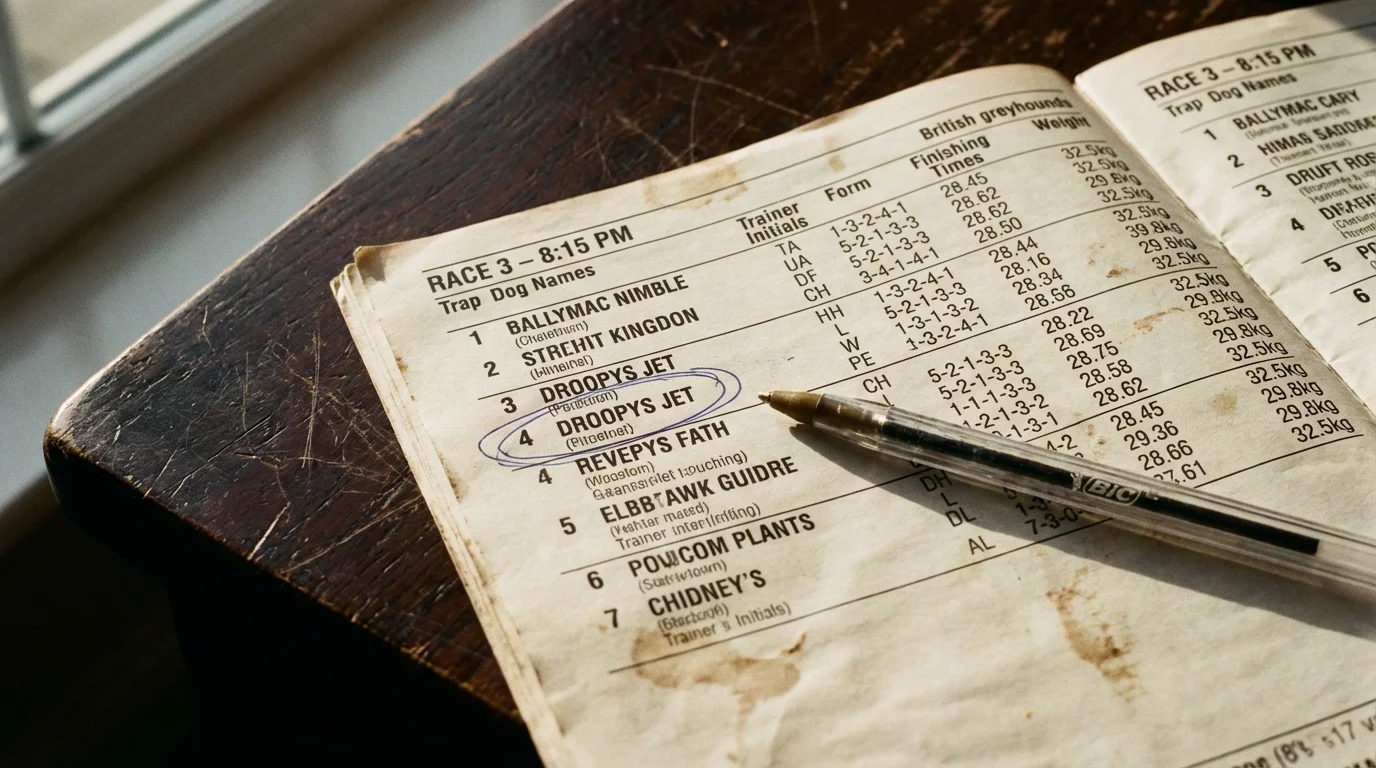
The form string is the headline, but the details underneath are where the real information lives. Check the race distance: was it the same distance as today's race? Look at the grade: did the dog achieve that form in an A3 or a D1? A dog showing 1-1-1 in D grade is not the same proposition as one showing 2-3-2 in A grade. Time is another critical column — the raw finishing time tells you how fast the dog completed the distance, but it needs context. A 29.50 over 480 metres at Romford on a dry night is a different performance from 29.50 at Nottingham on a wet one.
Weight is recorded to a tenth of a kilogram. Most serious punters look for consistency rather than absolute numbers — a dog that suddenly gains or loses more than a kilogram between runs may be dealing with fitness issues or, in the case of bitches, hormonal cycles. The trainer column matters too: certain kennels have strong records at specific tracks, and knowing which trainers consistently produce race-ready dogs is an advantage the racecard hands you for free.
Form Lines, Sectional Times and Going Reports
Sectional times break a race into segments. The first split — the time from traps to the first bend — tells you how fast the dog broke and whether it contested the early lead. The run-home time covers the final section from the last bend to the line. A dog with fast opening splits and slow closing splits is a front-runner that tires. A dog with slow first splits but strong closing sections is a finisher that needs luck in running to avoid trouble. Both profiles are legitimate, but they demand different conditions to succeed.
Calculated time — often labelled "calc" on detailed form databases — adjusts the raw time for interference in running. If a dog was bumped at the second bend and lost an estimated 0.20 seconds, its calc time will reflect what it would have run without that disruption. Calc times are more reliable than raw times for assessing true ability, though they are estimates and not all services calculate them identically.
Track conditions receive less formal reporting in greyhound racing than in horse racing, but they still warrant attention. Sand surfaces vary between meetings, and a time recorded on a dry card is not directly comparable to one recorded after rain. The principle for racecard reading is straightforward: do not compare raw times across different conditions without adjustment.
Trap Draw Strategy: Inside, Middle, Outside
Trap 1 does not win the most races by accident. Across thousands of BAGS races every year, the inside trap posts a win rate between 25 and 33 per cent, depending on the track — far above the 16.7 per cent you would expect if all traps were equal. The geometry is simple: the dog in trap 1 has the shortest path to the first bend and, if it breaks well, establishes the racing line before any rival can challenge. On tight tracks like Romford and Crayford, where the run to the first bend is short and the bends are sharp, this advantage is amplified. At wider circuits like Nottingham and Towcester, the effect is present but less pronounced.
Middle traps — 3 and 4 — are where most of the trouble happens. Dogs drawn here are flanked on both sides, and at the first bend they can be squeezed by a fast railer on the inside and a wide runner drifting in from the outside. If a middle-drawn dog does not have strong early pace, it risks getting bumped, checked or shut out entirely. For bettors, a quality dog drawn in trap 3 or 4 without clear early pace is a value question: is the price long enough to compensate for the increased risk of interference?
Outside traps — 5 and 6 — carry a geometric disadvantage on paper, since the dog covers more ground around every bend. But for wide-running dogs that are seeded into those traps because it matches their natural racing style, the outside can be an advantage. A wide seed in trap 6 gets a clear run to the first bend without traffic, and at tracks with generous bends, the extra ground covered is marginal. The key is distinguishing between a wide dog drawn wide (favourable) and a railer displaced to the outside because of draw allocation imbalances (unfavourable).
The GBGB's seeding system classifies every dog as a railer, middle tracker or wide seed based on its observed racing line. In open races and higher-grade events, dogs are drawn into traps that match their classification under Rule 80. In graded racing, the system is simpler but the principle holds. When a dog's seeding matches its trap, the draw is neutral. When there is a mismatch — a confirmed railer stuck in trap 5, or a wide runner crammed into trap 2 — the market should adjust, and often it does not adjust enough.
Inside Traps 1-2
Shortest path to the first bend. Ideal for railers with strong early pace.
Win rate: 25-33% at tight circuits.
Risk: crowding if the dog breaks slowly and gets bumped from behind.
Outside Traps 5-6
Clear running room if the dog is a natural wide seed.
Geometric disadvantage: extra ground on every bend.
Advantage: avoids first-bend scrimmaging. Strong at wide-bend tracks like Towcester.
Form Analysis and Picking Winners
Form is a story — and the latest chapter matters most. Greyhound form analysis begins with the most recent five or six runs, read in the context of the distance, grade and track where they were recorded. A dog showing improving finishing positions across its last three outings at the same track and distance is a different proposition from one whose form figures look strong but were achieved at a lower grade or a different circuit. The principle is simple: relevant, recent form beats historical highlights every time.
The most common mistake among casual punters is treating form figures in isolation. A string of 1-1-2 looks excellent until you check the grades and discover all three runs were in D class. That dog is now stepping into B grade for the first time, and the competition will be materially faster. Conversely, a form line of 4-3-5 in A grade might hide a dog that encountered interference in every run and whose calculated times suggest it is significantly better than its positions indicate. Reading form means reading context.
At UK tracks like Crayford and Romford, the dog that leads at the first bend wins over 60 per cent of the time. Early pace is the single strongest predictor in sprint races.
Early Pace, Bend Position and Finishing Speed
The first bend settles more races than the finishing straight. In sprints over 260 to 400 metres, the leader at the first bend converts at rates above 60 per cent at pace-favouring circuits. Even at standard four-bend distances, the first-bend leader wins more often than any other dog in the race. This is the single most important variable in short-form greyhound analysis: who gets to the front first?
Sectional data answers that question. The opening split — typically the first 150 to 200 metres from the traps to the first timing point — identifies the likely leader. Compare the recent first-split times of all six dogs in a race and you can build a picture of who will lead, who will track and who will be fighting for position through the first bend. When two or three fast breakers are drawn next to each other, interference is likely. When one dog has clearly superior early pace and is drawn on the inside, the combination of pace and position makes it a strong candidate.
Finishing speed matters more at demanding circuits. Nottingham and Towcester both punish front-runners that tire, because the long straights and sweeping bends allow closers to make up ground in the final 100 metres. At these tracks, a dog with moderate early pace but a strong run-home split can be a better bet than the fastest breaker — especially in graded races where the pace is evenly matched and the first bend is fiercely contested.
Trainer Patterns and Kennel Indicators
Behind every dog is a trainer, and trainers have patterns. Some kennels specialise in sprinters. Others produce stayers. Some trainers have exceptional records at specific tracks — a kennel based near Romford that runs dogs there every week will know the track surface, the pace demands and the grading tendencies better than a kennel travelling from three counties away. Checking trainer form at the specific track where today's race is held is a simple edge that most casual punters ignore entirely.
Kennel-level trends also reveal seasonal patterns. Bitches go in and out of season, and form can fluctuate sharply during hormonal cycles. A bitch returning from a break of three to six weeks may need a run or two to regain peak fitness. Trainers who manage these transitions well — returning dogs in condition and not rushing them back — tend to have better strike rates with post-season runners. These patterns show up in the data if you look: a trainer whose bitches consistently perform within two runs of returning is one whose kennel management you can trust.
Track specialisation extends to grading familiarity. A trainer who regularly grades dogs at Monmore will time their moves between classes more effectively than one who sporadically enters dogs at unfamiliar venues. When a kennel drops a dog at a track it knows well, the chances that the drop is tactical — designed to exploit a lower class rather than signal declining ability — are higher. That is value in disguise, and trainer awareness helps you spot it.
Track Conditions and External Factors
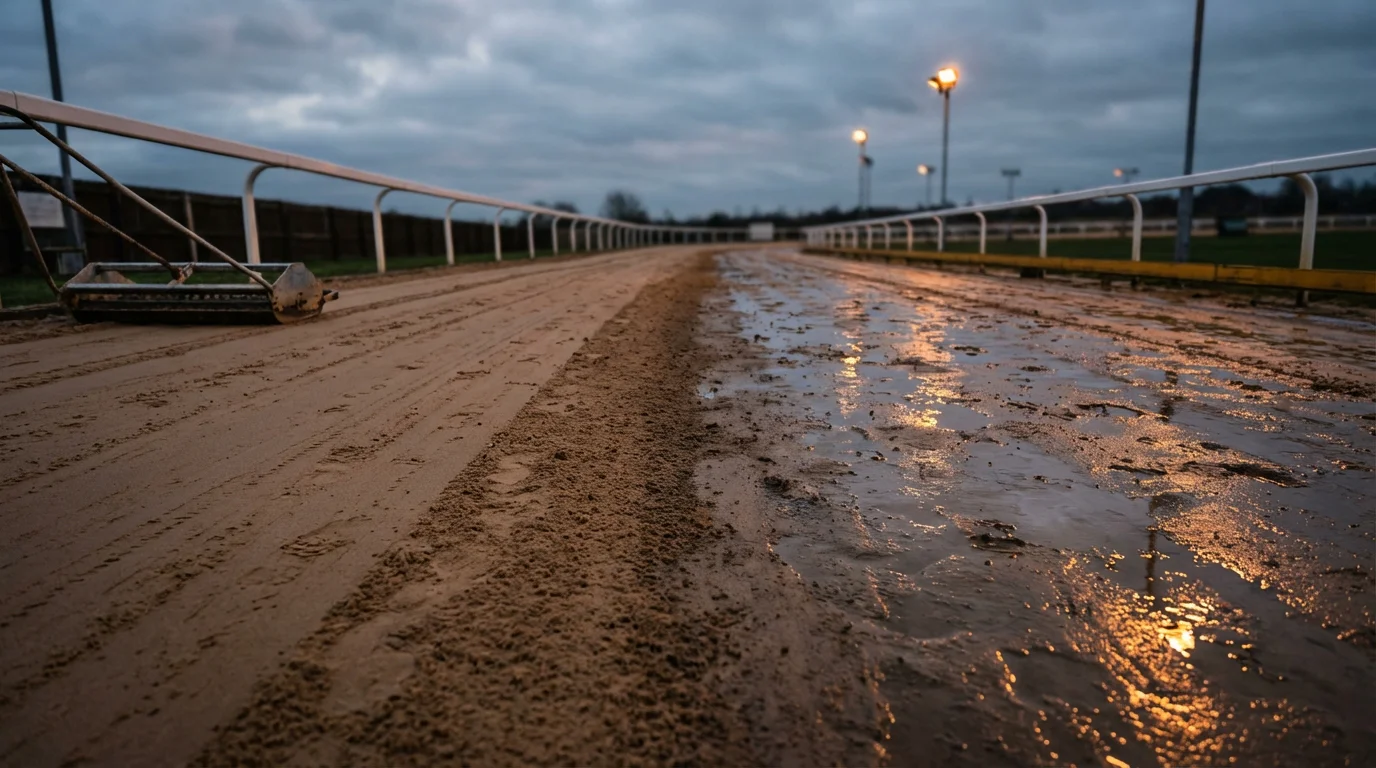
Sand looks the same until it rains. UK greyhound tracks use sand surfaces that are maintained between races, but the condition of that sand changes with the weather, the time of year and the intensity of the card. A dry, compacted surface is fast and rewards pace dogs — those with sharp early speed that can exploit firm ground. When rain loosens the surface and increases moisture content, the track becomes slower and more demanding, favouring strong, powerful runners that grip through the bends rather than glide across them.
The effect is not trivial. Overnight rain before an evening card can add measurable time to every race on the programme. Dogs that looked dominant on a dry Tuesday may struggle on a wet Friday when the surface demands a different physical attribute. Punters who check weather forecasts and, where available, track condition updates before finalising their selections have a genuine informational edge. Not every track publishes formal going reports the way horse racing does, but many now post updates through social media channels or official websites on raceday.
Greyhound track sand in the UK typically contains 8 to 12 per cent moisture. A 3 per cent increase from overnight rain can add roughly 0.15 seconds to finishing times over 480 metres — enough to change the result in a tight race.
Wind is another underappreciated factor. Exposed circuits — tracks without significant shelter from surrounding structures — are vulnerable to crosswinds that affect dogs differently depending on size and running style. A headwind on the back straight slows every runner, but lighter dogs feel it more. A crosswind on a bend can push a wide-running dog further off the racing line. These are marginal effects, but greyhound racing is decided by margins, and the punter who factors in conditions has a clearer picture than the one who ignores them.
Seasonal patterns matter as well. Summer cards run on firmer, faster ground. Winter racing often means softer surfaces and, at exposed venues, colder temperatures that can affect muscle performance. The 2026 BAGS calendar runs year-round, and dogs campaigned hard through winter may peak in spring when conditions improve and fatigue has not yet accumulated. Timing your assessment to account for where the dog sits in its seasonal cycle is part of the job.
Responsible Betting: Staying Sharp, Staying in Control
The fastest way to lose at the dogs is not backing the wrong trap — it is chasing the last result. Greyhound racing's rapid-fire schedule is its greatest appeal and its biggest risk. With races every 15 minutes, the temptation to recover a loss immediately is constant. Tilt — the emotional state where frustration overrides analysis — is the enemy of every serious bettor, and it thrives in environments with quick turnover.
Fixed staking is the foundation of bankroll discipline. Set a unit size — typically 1 to 3 per cent of your total betting bankroll — and apply it consistently. Do not double up after a loss or increase stakes because a dog "looks unbeatable." If your standard stake is two pounds, every bet should be two pounds unless you have a predefined structure for different confidence levels. Recording every bet — selection, odds, stake, result, profit or loss — turns vague feelings about how you are performing into hard data. After 100 bets, your records will tell you whether your approach is working, which tracks you profit at and which bet types deliver your edge.
Every UK-licensed bookmaker is required by the UK Gambling Commission to provide deposit limit tools, session time reminders, cooling-off periods and self-exclusion options. Use them. Setting a weekly deposit limit before you start is not a sign of weakness — it is a structural defence against the kind of impulsive decisions that accumulate over a long evening of racing. If you would not sit down at a poker table without a stop-loss, do not approach greyhound betting without one either.
If you are betting to recover losses rather than because you have found genuine value, stop. Take a break. Use the deposit limit tools every UK-licensed bookmaker is required to provide. Support is available from BeGambleAware at any time.
What Makes a Good Greyhound Betting Site
Not all bookmakers treat the dogs equally. Some platforms offer extensive greyhound coverage with deep market depth, live streaming of BAGS and evening meetings, detailed form data and competitive odds. Others treat greyhound racing as an afterthought, with limited markets, no streaming and odds that are consistently wider than the market average. The difference matters because the features available on your chosen platform directly affect both your ability to analyse races and the value you extract from your bets.
The starting point for evaluation is not branding or welcome offers — it is whether the bookmaker provides the tools a greyhound punter actually needs. Does it offer best odds guaranteed on UK greyhound races? Can you watch races live through its streaming service? Does it provide form data, or do you need to go to a third-party site for every racecard? Are forecast and tricast markets available for every BAGS meeting, or only for selected evening cards? These are the questions that separate a useful greyhound betting platform from a generic sportsbook with a dog racing tab bolted on.
Best Odds Guaranteed and Live Streaming
Best odds guaranteed — covered in depth in the odds section above — is the single most valuable feature for regular greyhound punters. The point bears repeating in a platform context: not all bookmakers offer BOG on greyhounds, and those that do may restrict it to certain meeting types or times of day. A platform without BOG on UK dogs is a platform that will cost you money over any meaningful sample of bets. Checking the exact terms before you commit is essential.
Live streaming access is the other non-negotiable. Watching races live allows you to assess how a dog runs in real time, spot trouble in running that the form figures cannot capture and confirm your understanding of pace dynamics at specific tracks. Most major UK bookmakers stream BAGS meetings through SIS or RPGTV feeds, but coverage of evening and featured cards can be patchier. A bookmaker that streams a broad range of meetings gives you more data and more opportunities than one that streams selectively.
Mobile Experience and Greyhound-Specific Promotions
Most greyhound betting happens on mobile. Whether you are at the track, following afternoon BAGS racing from a workplace, or analysing an evening card from the sofa, the mobile experience determines how efficiently you can place bets, check form and watch streams. A good greyhound betting app loads racecards quickly, allows one-tap access to forecast and tricast markets, and integrates live streaming without requiring you to navigate away from the bet slip.
Promotions specific to greyhound racing are rarer than general sportsbook offers but more valuable when they exist. Free bet clubs that reward regular greyhound betting with weekly free bets, tricast bonuses that boost returns on successful tricasts, and enhanced odds on selected evening meetings all provide marginal gains that compound over time. Evaluate these offers on their terms — minimum odds requirements, wagering conditions, expiry periods — rather than headline figures. A free bet with restrictive terms is worth less than a smaller offer with clean conditions.
Frequently Asked Questions
How do greyhound racing odds work, and what is the difference between SP and fixed price?
Greyhound odds represent the bookmaker's assessment of each dog's chance of winning, expressed as a ratio. Fractional odds of 7/2 mean you receive seven pounds profit for every two pounds staked, plus your stake back. The starting price (SP) is the final odds available on course when the traps open, determined by the weight of on-course money. A fixed price (also called early price) is the odds you lock in at the moment you place your bet. Because greyhound markets are smaller and less liquid than horse racing, the SP often drifts significantly from early prices. Best odds guaranteed (BOG) protects you by paying whichever is higher — the price you took or the SP — and is considered essential for regular greyhound punters.
Which trap number wins most often in UK greyhound racing?
Trap 1 wins more races than any other position across UK greyhound racing as a whole, posting win rates between 25 and 33 per cent depending on the track, well above the expected 16.7 per cent if all traps were equal. The advantage comes from geometry: the inside dog has the shortest path to the first bend. However, this advantage varies by circuit. Tight tracks like Romford and Crayford amplify the inside advantage, while wider circuits like Nottingham and Towcester reduce it. In open-class events such as the Greyhound Derby final, inside traps historically underperform because the quality of opposition neutralises the positional edge. Trap statistics should always be assessed on a track-by-track basis rather than applied as a blanket rule.
What is best odds guaranteed and which bookmakers offer it on greyhounds?
Best odds guaranteed (BOG) is a bookmaker feature that pays you at whichever is higher: the fixed price you took when placing your bet, or the starting price (SP) at the off. It matters particularly in greyhound racing because the smaller betting pools cause SPs to fluctuate more than in horse racing. Without BOG, you risk being stuck with a shorter price than the SP. Most major UK-licensed bookmakers offer BOG on greyhound races, but coverage varies. Some restrict it to UK races only, others limit it to certain meeting types or times of day, and a few exclude it from greyhounds entirely. Always check the specific BOG terms on your chosen platform before relying on it.
Beyond the First Bend: Where Greyhound Betting Goes from Here
Greyhound racing does not need saving — it needs punters who understand what they are watching. The sport has survived venue closures, regulatory upheaval and a cultural shift that moved betting from trackside to smartphone. What it has gained in return is accessibility: more data, more streaming, more markets and more ways for a prepared bettor to find edges that did not exist a decade ago. The 2026 racing calendar offers a full programme of BAGS meetings, evening cards and Category 1 events, with online platforms delivering form data and live video to a degree of depth that was unimaginable when greyhound betting meant standing in the rain at Wimbledon with a folded racecard.
The GBGB's continued investment in welfare standards, drug testing protocols and track licensing has strengthened the integrity of the sport. Rehoming programmes have improved dramatically. Public perception is shifting, slowly, in the right direction. None of this makes the racing less competitive or the betting less challenging — but it does mean the sport is building on a more sustainable foundation than at any point in its modern history.
If this guide has done its job, you now have a framework for approaching greyhound betting with structure rather than instinct. You understand the bet types, the odds mechanics, the form indicators and the external variables that shape race outcomes. The next step is application: pick a track, study its patterns, build a record and test your approach against real results. The edges in greyhound racing are real, but they compound only with repetition, discipline and an honest assessment of what the data tells you — especially when it tells you something you did not want to hear.
