Best Greyhound Betting Sites – Bet on Greyhounds in 2026
Loading...
- Odds Are a Language
- Fractional Odds — The UK Standard
- Decimal Odds — The Alternative Format
- Starting Price vs Fixed Price vs Early Price
- How Greyhound Odds Are Set and Why They Move
- Implied Probability: What Odds Actually Represent
- Tote Odds vs Fixed Odds
- Calculating Payouts: Singles, Each Way, Forecasts
- The Price of the Race Itself
Odds Are a Language
Every greyhound race starts with a price — and that price tells a story. It tells you what the market thinks about each dog’s chances. It tells you where the money has gone and where it hasn’t. If you can read odds fluently, you can identify not just which dog the bookmaker expects to win, but whether the bookmaker’s expectation is justified — and that distinction is where profitable betting begins.
Odds come in formats. In the UK, fractional odds remain the default at most bookmakers and on-course displays. Decimal odds are standard on betting exchanges and increasingly available as an option at traditional bookmakers. Starting price, early price, and fixed price describe when a price is taken, not how it’s expressed. Behind all of these formats is a single concept: probability translated into a number that tells you what you’ll be paid if your bet wins.
The punters who treat odds as decoration — glancing at the number beside a dog’s name and deciding whether it “looks good” — are working with the crudest possible version of the information available. The punters who treat odds as data — understanding what each price implies about probability, how the market adjusts, and where the bookmaker’s margin sits — are working with a meaningful edge. This guide breaks down every odds format you’ll encounter in UK greyhound racing, explains how prices are set and why they move, and shows you how to convert a number on a screen into a genuine assessment of value.
Fractional Odds — The UK Standard
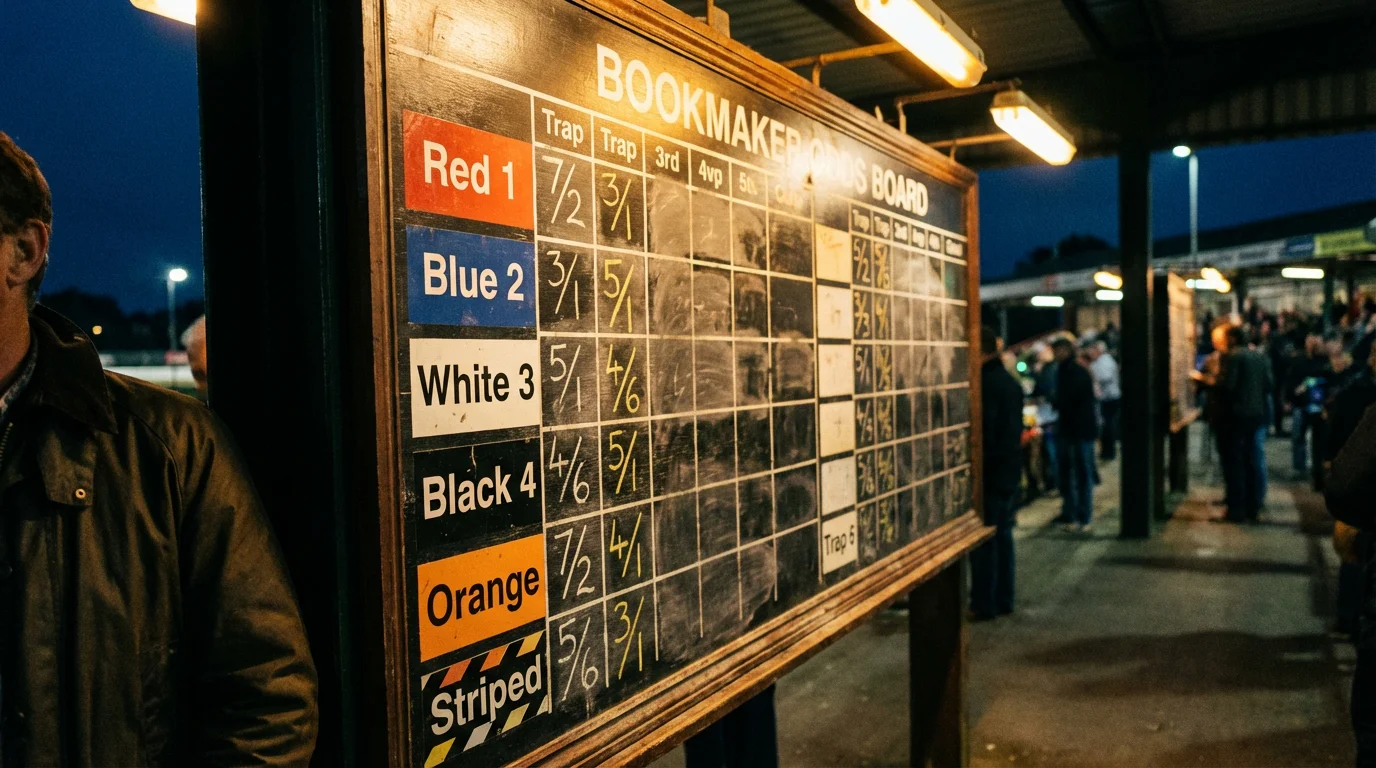
The slash in 7/2 is doing more work than it looks. Fractional odds are the traditional British format, and despite the rise of decimal alternatives, they remain the primary display at UK greyhound tracks, in betting shops, and across most domestic bookmaker sites.
The principle is simple. The number on the left (the numerator) tells you the profit you’ll make for every unit represented by the number on the right (the denominator). At 7/2, you win seven pounds for every two pounds you stake. Place £10, and your profit is £35. Add the stake back and your total return is £45. At 3/1, you win three for every one staked — £30 profit on a £10 bet, £40 total return. At evens (1/1), you double your money: £10 returns £20.
Where it gets slightly less intuitive is with odds-on prices — where the denominator is larger than the numerator. A dog at 4/6 means you win four pounds for every six staked. That’s less than your stake, which reflects the market’s view that this dog is more likely to win than lose. Stake £12 at 4/6 and you profit £8, for a total return of £20. At 1/3, you’re risking three to win one — the kind of cramped price that appears on dominant favourites in weak fields and is almost never worth taking unless you have a very specific reason.
Common greyhound fractional prices and their quick returns on a £10 stake look like this. At 4/6: £6.67 profit, £16.67 return. At evens: £10 profit, £20 return. At 6/4: £15 profit, £25 return. At 2/1: £20 profit, £30 return. At 3/1: £30 profit, £40 return. At 5/1: £50 profit, £60 return. At 10/1: £100 profit, £110 return. Memorising the common ones saves mental arithmetic at the counter and helps you evaluate prices instantly.
A useful shortcut for converting fractional odds to a return multiplier: divide the numerator by the denominator and add one. So 7/2 becomes (7 ÷ 2) + 1 = 4.5. Multiply your stake by 4.5 to get the total return. This is, incidentally, exactly what decimal odds represent, which is why conversion between the two formats is straightforward.
One common source of confusion: fractional prices like 11/8, 11/10, or 100/30 appear on greyhound markets alongside the rounder numbers. These aren’t exotic — they’re simply finer gradations of price. An 11/8 shot sits between evens and 6/4. The bookmaker uses these intermediate fractions to position the price precisely within the market. Don’t be put off by the less familiar numbers. Apply the same numerator-and-denominator logic and the return calculation is identical.
Decimal Odds — The Alternative Format
Decimal odds include your stake in the number — that one difference changes how you read them, and for many punters, it makes the maths easier.
Where fractional odds show profit relative to stake, decimal odds show total return per unit staked. A dog at 4.50 in decimal means a £1 bet returns £4.50 total — £3.50 profit plus the £1 stake. That 4.50 is the exact equivalent of 7/2 in fractional format. Evens (1/1) becomes 2.00 in decimal: stake a pound, get two back. A 3/1 shot is 4.00. A 10/1 outsider is 11.00.
The conversion formula is straightforward: the shortcut from the fractional section (numerator ÷ denominator + 1) gives you the decimal equivalent directly. So 5/2 becomes 3.50, and 4/6 becomes 1.67. Going the other direction, subtract one from any decimal price to get the fractional profit ratio: 3.50 − 1 = 2.50, which is 5/2.
Decimal odds dominate on betting exchanges like Betfair, where the precision of the format suits the granular pricing that exchange markets produce. You’ll see prices like 3.75 or 6.20 — levels that don’t translate neatly into traditional fractional equivalents. European and international bookmakers also default to decimal, so if you ever bet on Irish greyhound racing through a continental platform, you’ll encounter this format as standard.
The main practical advantage of decimal odds is comparison. When you’re looking at a field of six greyhounds and want to identify the favourite, the decimal format gives you the answer at a glance: the lowest number is the shortest price. In fractional format, comparing 5/4 with 11/8 with 6/4 requires mental conversion. In decimal — 2.25, 2.375, 2.50 — the hierarchy is immediate.
Decimal odds also simplify accumulator calculations. Multiply the decimal prices of each leg together, then multiply by your stake. Three selections at 2.50, 3.00, and 4.00 give a combined decimal price of 30.00 — a £1 stake returns £30. In fractional odds, the same calculation requires converting each leg, multiplying, and adding stakes back in, which is considerably more cumbersome.
Most UK bookmakers let you switch between fractional and decimal in their settings. There’s no strategic advantage to either format — the information is identical, only the expression differs. Use whichever you find more natural. If you’re comfortable converting between the two, you’ll occasionally spot a pricing error where the fractional display doesn’t match the decimal exactly, though these are rare and usually corrected quickly.
Starting Price vs Fixed Price vs Early Price
When you take a price matters as much as what price you take. In greyhound racing, the timing of your bet relative to the market’s development can be the difference between backing at value and backing at a loss before the race even starts.
Starting price (SP) is the official price at the time the traps open. In the UK, it’s determined by on-course bookmakers — the layers at the track who set a final market in the minutes before the off. For races without on-course markets (which includes many BAGS meetings), the SP is calculated from industry returns based on off-course bookmaker pricing. SP is the default for any bet placed without specifying a price. If you walk into a betting shop, put a slip on a greyhound, and don’t take a specific price, you get SP.
The problem with SP in greyhound racing is volatility. Greyhound betting pools are significantly thinner than horse racing pools. A single large bet on a dog in a BAGS race can move the SP dramatically. A dog that traded at 3/1 in the morning might go off at 2/1 if one substantial bet comes in, or drift to 9/2 if money piles onto a rival. For the SP bettor, this creates uncertainty: you don’t know what price you’re getting until the race starts. Sometimes SP is generous, delivering a longer price than the morning market suggested. Just as often, it’s shorter, and you’ve accepted a price you would have rejected had you seen it in advance.
Fixed price — also called early price — solves this problem. When a bookmaker publishes prices in advance of the race, you can take a specific price at the time of your bet. That price is locked in: whatever happens to the market between now and the off, your bet is settled at the odds you accepted. If you back a dog at 7/2 in the morning and the SP is 5/2, you’re paid at 7/2. The market moved against you, but your price didn’t.
Best odds guaranteed (BOG) eliminates the one downside of taking an early price. With BOG, if the SP is higher than the price you took, you’re paid at SP instead. You get the better of the two numbers. In practice, this means taking an early price at a BOG bookmaker is almost always the right play for greyhound betting: you lock in the price you’re happy with, and if the market drifts in your favour, you benefit anyway. BOG is standard across most major UK bookmakers for horse racing. For greyhounds, availability varies — some firms offer it on all races, others restrict it to certain meetings or time windows. Checking whether your bookmaker’s BOG policy covers greyhounds is one of the first things any serious dog bettor should do.
Early prices for greyhound races are typically published closer to the off than horse racing prices — often an hour or two before rather than the day before. This compressed window means you need to be ready to act quickly if you’ve done your pre-race analysis. Waiting until five minutes before the off to take a price risks finding the market has already moved, especially on shorter-priced selections where any meaningful bet pushes the price inward.
How Greyhound Odds Are Set and Why They Move
Bookmakers don’t guess — they calculate, then adjust. The opening prices for any greyhound race reflect an assessment of each dog’s chance based on form, ratings, and historical data. From that starting point, the market evolves as money comes in, and the final prices at the off can look very different from the opening show.
The initial pricing is typically set by a compiler — a specialist, often using proprietary ratings models, who assigns a probability to each dog and converts those probabilities into odds. The compiler considers recent form, sectional times, trap draw, class, trainer patterns, and any other factors that influence the outcome. The resulting prices are then adjusted to include the bookmaker’s margin, ensuring the total implied probability of all six runners sums to more than 100%. That excess is the overround — the bookmaker’s built-in profit on the race.
A typical greyhound race might have an overround of 115–125%, meaning the sum of all implied probabilities is 115% to 125% rather than the theoretical 100% of a fair market. In practical terms, this means that if you back every dog in the race at the offered prices, you’re guaranteed to lose roughly 15–25% of your total stake. The overround is higher on greyhound races than on horse racing, partly because the smaller fields concentrate the margin across fewer runners and partly because greyhound betting pools are less liquid, giving bookmakers more pricing power.
Once the market opens, prices move in response to money. When a dog attracts significant betting volume, the bookmaker shortens its price to limit liability on that outcome. As one dog’s price contracts, the prices of the other runners lengthen to maintain the overall margin. A heavily backed 3/1 favourite might be cut to 2/1, and the 5/1 second favourite drifts to 6/1 as a result. This isn’t a judgment on ability — it’s a response to betting patterns. The bookmaker’s goal is to balance the book, not to predict the winner.
For the punter, understanding this process reveals two things. First, a shortening price doesn’t always mean a dog is more likely to win — it means more people are betting on it, and those people might be wrong. Second, a drifting price doesn’t mean a dog has become less likely to win. It may simply be that money has gone elsewhere and the bookmaker has eased the price to attract more balanced betting. If your analysis says a dog is a genuine contender and its price is drifting, the drift may be offering you value rather than warning you off.
Watching how a greyhound market moves in the final fifteen minutes before the off is informative. Sharp contractions on a specific runner sometimes indicate informed money — trainers, kennel connections, or experienced track regulars backing a dog they’ve seen trial well. Gradual, steady movement across the field is usually a sign of normal public betting. Distinguishing between the two is an acquired skill, but it starts with simply paying attention to the market and noticing patterns over time.
Implied Probability: What Odds Actually Represent
A 3/1 shot isn’t just a return — it’s a 25% chance, according to the market. Converting odds into implied probability is the skill that transforms you from a punter who takes prices into a punter who evaluates them.
The conversion is simple. For fractional odds, divide the denominator by the sum of the numerator and denominator. At 3/1: 1 ÷ (3 + 1) = 0.25, or 25%. At evens: 1 ÷ (1 + 1) = 0.50, or 50%. At 5/1: 1 ÷ (5 + 1) = 0.167, or 16.7%. For decimal odds, divide 1 by the decimal price. At 4.00 (which is 3/1): 1 ÷ 4 = 0.25, or 25%. At 2.00 (evens): 1 ÷ 2 = 0.50. The formula is the same concept in different notation.
The critical insight is that these implied probabilities include the bookmaker’s overround. If you add up the implied probabilities of all six dogs in a race, the total will exceed 100% — typically by 15 to 25 percentage points. That excess is the bookmaker’s edge, distributed across the field. It means every dog’s implied probability is slightly inflated compared to its true chance of winning.
To estimate true probability, you need to remove the overround. The simplest method is proportional. Calculate each runner’s implied probability, sum them all, then divide each individual probability by the total. If the six dogs in a race have implied probabilities of 35%, 25%, 18%, 12%, 7%, and 6% (totalling 103%), the favourite’s true probability is approximately 35 ÷ 103 = 34%. The maths isn’t perfectly precise — more sophisticated methods exist for removing margin — but it’s accurate enough for practical betting decisions.
Why does this matter? Because value betting — the foundation of long-term profitability — is about finding dogs whose true probability of winning is higher than the probability implied by their odds. If your analysis tells you a dog has a 30% chance of winning and the bookmaker is offering 4/1 (implied probability 20%), the market is underestimating that dog by ten percentage points. That’s a value bet. If the same dog is offered at 2/1 (implied probability 33%), the market has priced it fairly or even slightly tight. Same dog, same race, different conclusion — and the difference is entirely about converting odds to probability and comparing the result with your own assessment.
You don’t need to calculate implied probabilities for every dog in every race. But for the races where you have a strong opinion — a well-backed analysis of form, draw, and conditions — running the numbers takes thirty seconds and tells you whether the available price justifies the bet. If it does, you’ve found value. If it doesn’t, you’ve saved a stake for a race where the maths works in your favour.
Tote Odds vs Fixed Odds
The tote doesn’t set prices — the punters do. Pool betting, offered through the tote at UK tracks and via some online services, works on a fundamentally different principle from fixed-odds betting, and understanding the difference lets you choose the right vehicle for each bet.
In fixed-odds betting, the bookmaker offers a price and you accept or reject it. Your return is determined at the point of placing the bet (or at SP if you don’t take a price). The bookmaker carries the risk of the odds being wrong. In pool betting, every stake goes into a communal pot. After the tote operator takes a deduction — typically between 15% and 30% depending on the pool type — the remaining pot is divided among winning bettors in proportion to their stakes. The dividend (the pool equivalent of odds) isn’t known until after the race, because it depends on how much money is in the pool and how many people backed the winner.
For greyhound win bets, the tote dividend and the fixed-odds SP are usually in a similar range, though they can diverge. On a heavily backed favourite, the tote dividend is often shorter than the fixed-odds SP because a large chunk of the pool is concentrated on one dog. On outsiders, the tote can occasionally be more generous, because fewer people have backed the winner and the pool is divided among fewer tickets.
Where the tote becomes genuinely interesting in greyhound racing is on forecast and tricast bets. The declared forecast and tricast dividends — paid from the forecast and tricast pools — can be significantly different from bookmaker-priced equivalents. In races where an unexpected result occurs, the pool dividend can vastly exceed the fixed-price payout because the pool money was concentrated on other combinations. A tricast involving three outsiders might pay £400 from the tote while the bookmaker’s fixed tricast pays £250. The reverse is also true: a tricast involving the top three in the market might pay less from the tote than the fixed price, because many punters had the same combination.
The practical choice depends on what you’re betting. For win singles, fixed odds with BOG is almost always superior to the tote because you know your price in advance and BOG protects you from adverse movement. For forecasts and tricasts, the decision is more nuanced. If you’re backing a popular combination, the fixed price may offer better value. If you’re targeting an unusual combination that few other punters will have, the tote pool is likely to produce a more generous dividend. The tote rewards originality; fixed odds reward certainty. Your betting style determines which matters more.
Calculating Payouts: Singles, Each Way, Forecasts
Let’s run the numbers. The ability to calculate returns quickly — in your head or on a phone — is a basic but essential skill that prevents surprises when the bet is settled and helps you assess whether a price is worth taking before you commit.
Win singles are the simplest. Multiply your stake by the fractional odds to get the profit, then add the stake back. A £10 bet at 7/2: profit is £10 × (7 ÷ 2) = £35, total return = £45. In decimal format, multiply the stake by the decimal price: £10 × 4.50 = £45. Same answer, fewer steps. At odds on, the principle is identical. A £10 bet at 4/6: profit is £10 × (4 ÷ 6) = £6.67, total return = £16.67.
Each way bets require two calculations. The win part is paid at full odds if the dog finishes first. The place part is paid at one quarter of the odds if the dog finishes first or second. A £5 each way bet costs £10 total (£5 win, £5 place). If the dog wins at 5/1: win return = £5 × 5 + £5 = £30; place return = £5 × (5 ÷ 4) + £5 = £11.25; total = £41.25. If the dog finishes second: win part loses (−£5); place return = £11.25; net result = +£1.25 profit on the overall £10 outlay. At 3/1, the place part pays at 3/4: a second-place finish returns £5 × 0.75 + £5 = £8.75 against a £10 total stake — a net loss of £1.25. That’s why each way value in six-runner fields starts at around 4/1.
Forecast returns depend on the declared dividend. The tote or computer straight forecast (CSF) dividend is announced after the race and represents the return per £1 unit stake. If you placed a £2 straight forecast and the declared dividend is £35.40, your return is £2 × £35.40 = £70.80. A reverse forecast at £1 per line costs £2 (two straight forecasts), and whichever combination lands pays at the declared dividend for that specific result on a £1 unit.
Tricast returns work identically. The declared tricast dividend might be £185.60 to a £1 stake. A £1 straight tricast returns £185.60. A combination tricast covering three dogs in all orders costs £6 (six permutations at £1 each), and the winning permutation pays at the declared dividend for that finishing order on a £1 unit. The other five permutations lose.
For accumulators, the payout compounds across legs. Multiply the decimal odds of each winning selection together, then multiply by the stake. Three winners at 2.50, 3.00, and 2.00: combined decimal = 2.50 × 3.00 × 2.00 = 15.00. A £5 stake returns £75. Each losing leg reduces the return to zero.
The Price of the Race Itself
An odds-on favourite that drifts to 6/4 at the off isn’t the same bet it was ten minutes ago. The price changed, which means the market’s assessment changed, and the bet you placed — or chose not to place — needs to be evaluated in the context of the price it carried, not the one you expected.
Understanding odds isn’t a standalone skill. It’s the foundation of every other betting decision. When you read a racecard, you’re assessing form, draw, and conditions — but the output of that assessment is a judgment about probability. Is this dog a 25% chance? A 40% chance? The answer only becomes useful when you compare it to the implied probability in the market price. A dog you rate at 30% and the market rates at 25% (4/1) is a bet. The same dog at 33% (2/1) is not. Your opinion of the dog didn’t change. The price did, and the price is what makes or breaks the value.
Odds fluency also protects you from common traps. Short-priced favourites are the most popular bet in greyhound racing and the least profitable over time. Not because favourites don’t win — they win roughly a third of all races — but because the prices don’t compensate adequately for the frequency of losing. A favourite at 4/6 needs to win 60% of its races to break even. Most favourites don’t clear that bar. Knowing the implied probability instantly tells you whether the price is fair before emotion or habit takes over.
The punters who build long-term results in greyhound betting are the ones who think in terms of price, not just selection. They don’t ask “will this dog win?” — they ask “is this dog’s chance of winning higher than the price implies?” The distinction sounds academic, but it’s the difference between betting and gambling. Betting has a method. Gambling has a hunch. Odds literacy is what connects the two — and every concept in this guide, from fractional notation to overround to implied probability, exists to help you ask the right question before the traps open.