

Two Kinds of Competition
Not every greyhound race on the card operates under the same rules. The distinction between graded and open races is fundamental to how UK greyhound racing is structured, and it directly affects how you should read the form, assess the odds, and approach your betting. A graded A5 race and an open race at the same track, over the same distance, on the same evening, are different propositions — different in the quality of the field, different in the way the trap draw was determined, and different in the competitive dynamics that will shape the result.
Understanding this distinction is one of the sharper tools in a greyhound punter’s kit. It influences selection, staking, and the market types that offer the best value on any given race.
Find more race guides at greyhoundracingbettinguk.
What Makes a Graded Race
Graded races are the standard format that makes up the bulk of every UK greyhound meeting. The defining feature is that the racing manager controls both the field composition and the trap draw. Dogs are entered based on their current grade — the ability band assigned to them by the track’s grading system — and they’re drawn into specific traps based on their running style.
This means a graded race is a managed competition. The racing manager selects six dogs of broadly similar ability, then assigns trap positions designed to reduce interference: railers go inside (traps 1 and 2), middle seeds go into the central traps (3 and 4), and wide runners go outside (traps 5 and 6). The intention is to produce a competitive, fairly run race where each dog has a reasonable chance from its starting position.
The implications for punters are significant. In a graded race, the trap draw reflects the racing manager’s assessment of each dog’s preferred running line. A dog in trap 1 is there because the racing manager believes it’s a railer. A dog in trap 6 is there because it’s been identified as a wide runner. This seeding provides useful information — you know, before checking the form, that the trap assignment reflects the dog’s running style to some degree. It’s a built-in indicator that doesn’t exist in open races.
Graded races also tend to produce tighter finishes, because the field is composed of dogs at a similar ability level. The favourite in a graded race is often a narrow favourite — the difference between the top dog and the third or fourth best in the field may be marginal. This compression of ability makes graded races harder to call with confidence but also means that small edges — a draw advantage, a trainer in form, a class dropper — can be decisive.
The majority of your greyhound betting will be on graded races. They form the backbone of every meeting, and the depth of form available — because dogs at the same grade race regularly against each other — makes graded racing the most analysable category in the sport.
What Makes an Open Race
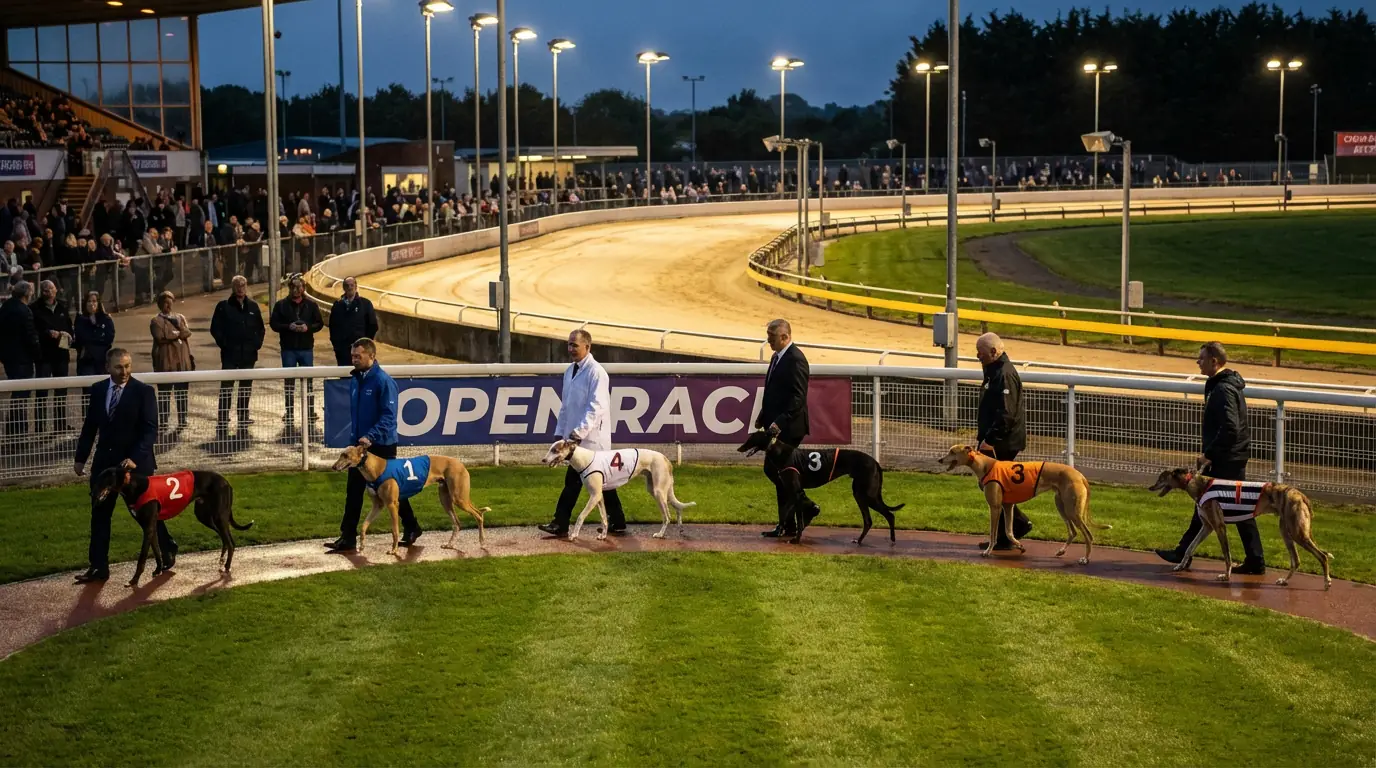
Open races are unrestricted by grade. Any dog entered by its trainer can compete, regardless of its current grading band. The fields are typically stronger, because the absence of grade restrictions means the best dogs at the track — and sometimes the best dogs from other tracks — can all appear in the same race. Open events are the feature races: they carry more prize money, attract more attention, and generate the biggest betting markets of the evening.
The critical difference for punters is the trap draw. In an open race, the draw is typically random or determined by a ballot rather than by the racing manager’s seeding. This means a confirmed railer might end up in trap 5, and a wide runner might be drawn in trap 2. The protective seeding that graded races provide doesn’t apply. Every dog races from whatever trap the draw assigns, and the interaction between running style and trap position is unpredictable until the draw is published.
This unsettled draw creates both danger and opportunity. The danger is that a strong form dog drawn against its preferred running style will underperform — a class act stuck in the wrong trap is still a class act, but its chance of winning drops measurably. The opportunity is that the market doesn’t always adjust fully for draw mismatches. A dog at 3/1 in an open race with an awkward trap draw might genuinely be a 5/1 chance once you factor in the draw. Conversely, a dog at 6/1 with a perfect draw for its running style might be a better bet than the favourite.
Open races also bring together dogs from different grades, which means the form comparison is more complex. A dog dropping from the open class to an A2 grade is a known quantity; a dog running in an open race that has been competing at A5 is stepping up into unknown territory. Assessing whether a dog’s graded form translates to open competition requires judgement about the absolute quality of the times it’s been recording, not just its results against grade-level opposition.
Feature open races — those televised or forming part of a major competition like the Derby heats — carry additional intensity. The dogs are faster, the pace is higher, the first-bend traffic is fiercer, and the consequences of interference are amplified because every dog in the field is capable of winning. For punters, open feature races offer the most liquid betting markets, the best streaming coverage, and often the tightest bookmaker pricing — making value harder to find but the analytical challenge more rewarding.
How Class Affects Odds
The quality of the field directly influences the odds structure of a race, and the distinction between graded and open races produces systematically different pricing patterns.
In graded races, the field is composed of dogs at a similar ability level. This means the favourite is typically priced between evens and 2/1, and the outsider is rarely longer than 8/1 or 10/1. The spread from favourite to outsider is compressed because the dogs are genuinely close in ability. For punters, this compression means the favourite wins less often than its price suggests (because the margin between it and its rivals is small), and the second and third favourites can represent value — particularly when the draw or running style favours them over the market leader.
In open races, the spread can be wider. When genuinely elite dogs run alongside competent-but-outclassed rivals, the favourite may be priced at 4/6 or shorter, with the outsider drifting to 14/1 or beyond. The market is less compressed because the ability gap between the best and worst dogs in the field is larger. For punters, open races with a dominant favourite present a different challenge: is the favourite’s price short enough to reflect its genuine superiority, or has the market overdone it? A 4/6 shot in an open race that encounters first-bend trouble from a random draw is not the certainty its price implies.
The bookmaker’s overround also tends to differ. Graded races, with their tighter pricing and more predictable outcomes, sometimes carry a lower overround than open races, where the wider price spread gives bookmakers more room to build in margin on the outsiders. Checking the market percentage before placing a bet — adding up the implied probabilities of all six runners — tells you how much edge the bookmaker has built into the race. A market that sums to 118% leaves more room for value than one that sums to 125%.
Graded Value, Open Prestige
The most consistent betting value in greyhound racing tends to come from graded races. The form is deeper, the seeding is informative, the fields are more predictable, and the ability compression means that small analytical edges — a draw advantage, a class drop, a trainer in form — can turn marginal selections into winning ones. Graded racing rewards the patient, methodical punter who does the homework and exploits the margins.
Also read our how greyhound grading works.
Open races are where the sport’s prestige lives. The best dogs, the biggest prizes, the most competitive fields. They’re more volatile, more exciting, and more difficult to bet profitably — but when you do find an edge in an open race, it often comes at a bigger price, because the market is working with less predictable information. Treat graded races as the foundation of your betting activity and open races as the highlight events where you back your best opinions with selective, well-reasoned stakes.
