Best Greyhound Betting Sites – Bet on Greyhounds in 2026
Loading...
The Numbers Behind the Boxes
Trap 1 doesn’t win a third of all races by coincidence. Across UK greyhound racing, inside traps — and trap 1 in particular — carry a measurable statistical advantage over their outside counterparts. The data is clear, it’s consistent, and it’s been documented across decades of results from every licensed track in the country. Yet most punters either ignore trap draw entirely or treat it as a tiebreaker rather than a primary factor.
That’s a mistake. The trap your dog starts from influences its path to the first bend, its exposure to crowding and interference, and its overall race position at the point where most greyhound races are effectively decided. Understanding the data behind trap draw — and understanding why the numbers look the way they do — gives you a structural edge in reading races that pure form analysis alone can miss.
UK Trap Win Percentages — The Data
The numbers across thousands of races paint a clear picture. When you aggregate UK greyhound results across all licensed tracks, the win distribution by trap follows a consistent pattern year after year. Trap 1 wins approximately 19–21% of all races. Trap 2 wins around 16–18%. Trap 3 and Trap 4 sit close together at roughly 15–17%. Trap 5 drops to about 14–16%, and Trap 6 typically wins 13–15%. In a perfectly even sport, each trap would win 16.7% of the time. The deviation from that baseline is small in percentage terms but significant over volume.
Those aggregate figures mask considerable variation between individual tracks. Every UK greyhound circuit has its own geometry — different bend radii, run-up distances, track widths, and straight lengths — and these physical characteristics shift the trap bias in ways that can be dramatic. At some tight-bended tracks, the inside rail advantage is amplified: trap 1 might win 22–24% of races, while trap 6 languishes below 12%. At wider, more galloping tracks with long straights and gentle bends, the distribution flattens. The outside traps are less penalised because dogs have more room to find their position before the first bend.
The type of race matters too. In graded races, where the racing manager seeds dogs into traps based on their running style — railers inside, wide runners outside — the trap bias is partly offset by deliberate allocation. A dog in trap 6 in a graded race has typically been drawn there because the racing manager considers it a wide runner suited to that position. In open races, where seeding is less structured and the competition is often stronger, the raw trap advantage tends to reassert itself more forcefully because dogs are not necessarily matched to their preferred running position.
Distance plays a role as well. Sprint races over shorter distances amplify trap draw because there’s less time to recover from a poor start or first-bend position. Over standard four-bend distances (460–500m), the advantage of inside traps remains significant but the extra distance allows more overtaking. In stayer and marathon races (600m+), where dogs negotiate six or more bends, the cumulative advantage of rail position can actually increase again because the inside dog saves ground on every bend.
The most useful approach is to look at track-specific data rather than national averages. Services like Timeform and the Racing Post publish trap statistics for individual UK circuits, broken down by distance and race type. These numbers tell you not just that inside traps win more often across the country, but exactly how much they win at the specific track and distance where your next bet is running. That specificity is what turns a general principle into an actionable edge.
Why Inside Traps Have an Advantage
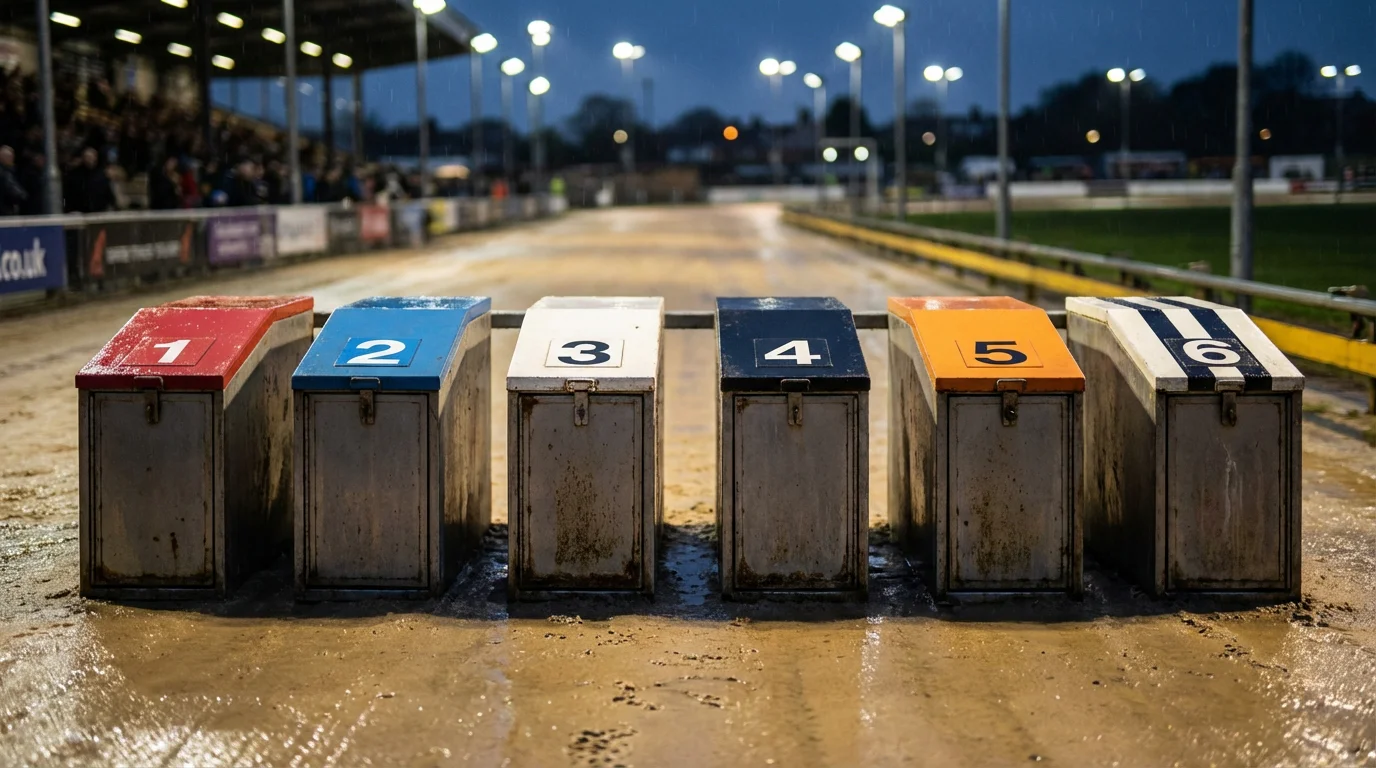
Shortest route to the first bend — that’s the geometry of it. Every greyhound track is an oval, and every oval has the same fundamental property: the inside lane covers less distance than the outside. In a footrace on a running track, athletes in the outer lanes get a staggered start to compensate. In greyhound racing, all six dogs break from the same line. The dog in trap 1 has the shortest path to the inside rail and the first bend. The dog in trap 6 has the longest.
That difference in distance might seem trivial — a matter of metres — but in a sport where the first bend is reached within three or four seconds of the traps opening, every fraction of a second counts. The dog that reaches the bend first and secures the rail position runs the shortest possible route for the rest of the race. The dog that arrives at the bend second or third from the outside must either check its stride, lose ground navigating wide, or risk bumping into dogs already occupying the inside line.
The first bend is where most greyhound races are shaped. It’s where early pace is rewarded, where crowding occurs, and where dogs either find racing room or lose it. A fast-starting dog drawn inside has two advantages: a shorter run to the bend and immediate access to the rail. A fast-starting dog drawn outside has to cross ground laterally as well as forward, which takes more time and more energy, and often puts it in the path of other dogs moving toward the rail.
The physics don’t stop at the first bend. On every subsequent bend, the dog running on the inside rail covers less ground than the dog running wide. Over four bends in a standard race, the difference between rail and wide amounts to several metres — which, in a sport decided by lengths and half-lengths, is not marginal. It’s structural. The trap draw isn’t a small factor dressed up as a big one. It’s a genuine spatial advantage embedded in the geometry of oval racing.
When Outside Traps Win
Wide runners drawn wide aren’t always at a disadvantage. The aggregate numbers favour inside traps, but they don’t tell the whole story. There are specific circumstances where a dog drawn in trap 5 or 6 can turn its position into an asset rather than a handicap — and recognising those situations is what separates punters who use trap data intelligently from those who blindly follow the numbers.
The most common scenario is seeding alignment. In graded races, racing managers assign traps based on known running styles. A dog that races wide — one that naturally moves to the outside off the first bend and runs its race around the field — is typically drawn in trap 5 or 6 precisely because that’s where it performs best. For this type of dog, an outside draw isn’t a penalty; it’s a clear run. It avoids the congestion on the inside, takes its preferred route, and if it has the pace to lead or sit prominently, the wider path can actually be an advantage over dogs that get boxed in on the rail.
First-bend trouble works in outside traps’ favour too. When inside-drawn dogs clash at the first bend — and in competitive races this happens regularly — the carnage is concentrated on the rail. Dogs bump, check, and lose momentum. Meanwhile, a cleanly-away runner from trap 5 or 6 can sweep around the outside of the trouble and emerge from the first bend in a leading position despite starting further from the rail. These are the races that skew the statistics back toward the outside: high-quality, competitive affairs where the inside isn’t a smooth channel but a collision zone.
Certain tracks also have a weaker inside bias than the national average. Wider circuits with more gradual bends reduce the distance saving that inside position provides. Some tracks have a specifically noted trait where certain distances favour outside draws because of how the starting boxes are positioned relative to the first bend. At tracks where the run to the first bend is very short, inside dogs can get crowded before they reach full speed, while outside dogs have fractionally more space to stride out. Checking track-specific data before assuming inside is always superior will occasionally reveal opportunities the market has mispriced.
Using Trap Data in Your Bets
Trap data is context, not a system. Backing trap 1 in every race regardless of form, distance, or track conditions is not a strategy — it’s a reflex, and a losing one over time despite the statistical edge. The overround ensures that bookmakers already factor trap advantage into their pricing. A trap 1 dog in a six-runner race isn’t secret information; the market knows, and the odds reflect it.
Where trap data becomes genuinely valuable is as a filter layered on top of form analysis. When two dogs look evenly matched on form, sectionals, and class, the trap draw can be the deciding factor. When a strong form dog is drawn awkwardly — a confirmed railer stuck in trap 6, or a wide runner squeezed into trap 1 — the draw flags a potential underperformance that the form alone wouldn’t predict. And when the draw aligns with the running style, it reinforces a selection you’ve already made on merit.
Study the numbers for your preferred tracks, understand the geometry behind them, and use the draw as one lens in a wider assessment. That’s how trap data pays.