Best Greyhound Betting Sites – Bet on Greyhounds in 2026
Loading...
What the Clock Reveals
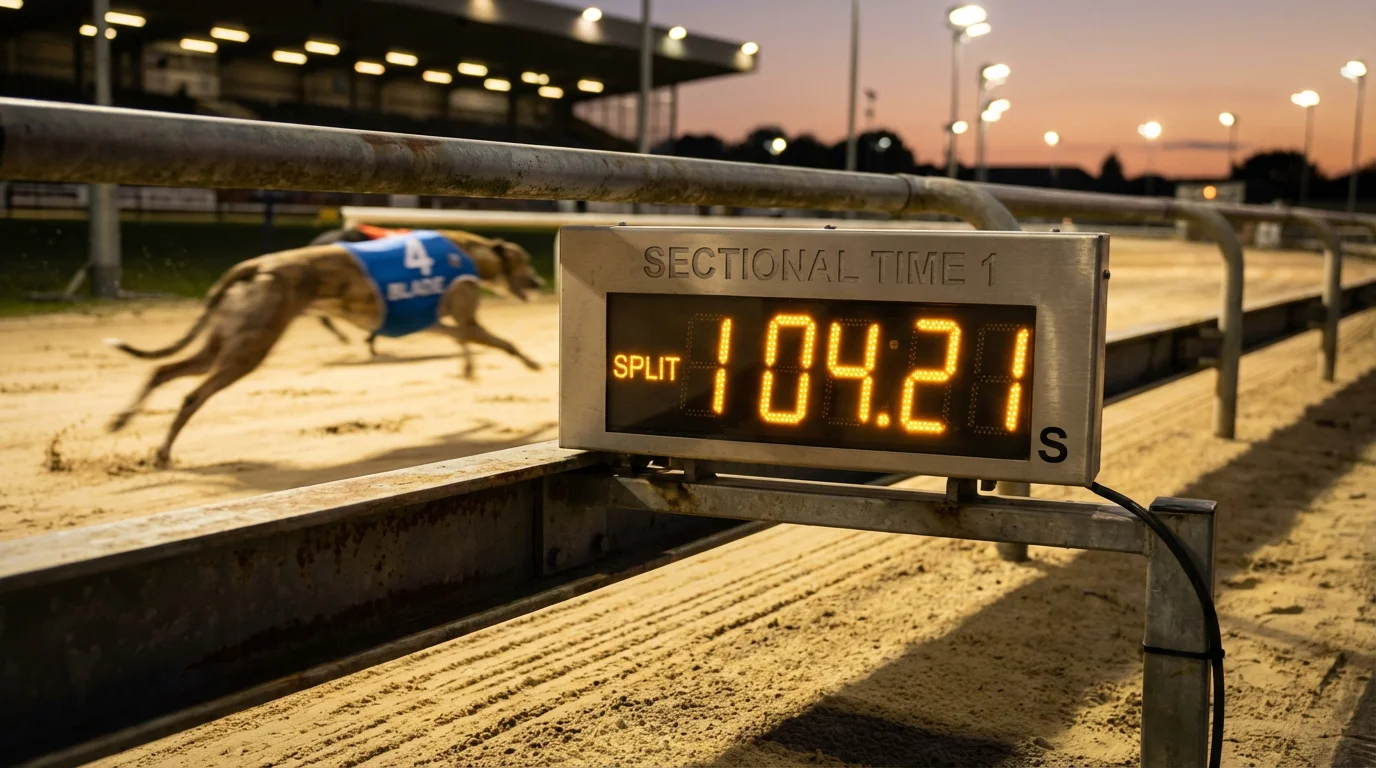
Sectionals reveal what overall time hides. A greyhound’s finishing time tells you how fast it completed the race, but it says nothing about how that time was constructed — whether the dog blazed the first bend and faded, whether it was impeded early and flew home, or whether it ran an even pace throughout. Two dogs can record identical overall times in the same race and have run completely different races. The total time is the headline; the sectional splits are the story underneath.
For serious greyhound punters, sectional times are the most granular form tool available. They break a race into stages — typically the run to the first bend, the middle section, and the finishing split — and measure how each dog performed at each stage. This information exposes hidden quality that the result alone can’t capture, and it’s the foundation of the kind of analysis that consistently finds value in markets where most punters are looking only at positions and overall times.
What Sectional Times Measure
Most UK greyhound tracks record sectional times using electronic timing systems triggered as the dogs pass specific points on the circuit. The exact timing points vary by track, but the standard framework divides the race into three measurable stages.
The run to the first bend. This is the opening sectional — the time from the traps opening to the dog reaching the first bend. It’s typically a distance of 40–80m depending on the track configuration and the position of the starting boxes relative to the first turn. This split measures raw trap speed and early pace: how quickly the dog breaks, how well it accelerates, and what position it reaches the bend in. A dog with consistently fast first-bend splits is a natural front-runner. A dog with slow first-bend times but good overall race times is a closer — it’s losing ground early and making it up later.
The mid-race section. This covers the middle bends — typically the second and third bends in a standard four-bend race. The mid-race split tells you about a dog’s cruising speed and its ability to maintain pace through the bends where most positional changes happen. Dogs that lose time through the mid-section are often those that race wide, get bumped, or simply can’t sustain their early effort. Dogs that gain ground through the middle of the race are running efficiently and are typically well-placed heading into the finish.
The finishing split. This is the time from the final bend to the finishing line — the run-home. It measures how much a dog has left at the end of the race and, crucially, how it finishes under pressure. A strong run-home split indicates a dog with stamina reserves and finishing determination. A weak run-home split — slower relative to the dog’s earlier sections — suggests it’s either tiring or simply not a strong finisher.
Not all tracks publish all three sections. Some provide only the first-bend split and the overall time, from which you can calculate the combined remaining split. Others provide more granular data through services like Timeform or specialist form databases. The more sections available, the more complete your picture of how each dog ran its race. But even a single sectional — the time to the first bend — is enormously valuable because it tells you who led, who was prominent, and who was off the pace at the point in the race where most results are decided.
Calculated Times Explained
The clock doesn’t lie — but it needs context. That’s where calculated times come in. A “calc” time (sometimes called an adjusted time) is an estimate of what a dog would have run had it experienced a clear, interference-free trip. It compensates for trouble in running — being bumped on a bend, checked at the first turn, carried wide by another dog — that added time to the dog’s actual finishing time through no fault of its own.
Calculated times are produced by race analysts (Timeform is the best-known provider in the UK) who watch the race, identify where a dog lost ground due to interference, and estimate how many lengths that trouble cost. Those lost lengths are then converted into a time adjustment and subtracted from the actual finishing time. The result is a figure that represents the dog’s underlying ability more accurately than the raw time.
For example, a dog finishes a 480m race in 29.85 seconds but was bumped on the second bend and carried wide on the third, losing an estimated two lengths. At typical greyhound speed, two lengths equates to roughly 0.12–0.15 seconds. The calculated time might therefore be recorded as 29.70 — reflecting the analyst’s assessment of what the dog could have run without the interference.
Calculated times are not exact. They involve human judgement about the severity of the trouble and the likely impact in seconds, and reasonable analysts can disagree on the adjustment. But they’re far more useful than raw times alone, because greyhound racing is a contact sport at its core — dogs bump, check, crowd, and interfere with each other on almost every bend. A dog that records a slow time because it was baulked at the first turn has not actually run badly; its raw time just doesn’t reflect its true ability on that run.
The practical application for punters is straightforward. When comparing form across runners in an upcoming race, use calculated times rather than actual times wherever available. A dog with a fast calculated time from a trouble-filled run is potentially better than a dog with a fast actual time from a clear run — because the first dog achieved its underlying speed despite adversity, while the second may have benefited from a trouble-free trip that might not recur. Calculated times strip away the noise and leave you with a cleaner comparison of genuine ability.
Using Sectionals to Find Value
The real power of sectional analysis lies in identifying dogs whose ability is masked by their finishing positions. The market prices runners largely on recent results — wins, places, beaten distances. What the market often fails to account for is how those results were achieved. Sectionals fill that gap.
Improving run-home splits. A dog whose finishing sectional has been getting faster over its last three or four runs is a dog that’s gaining fitness, finding its stride, or both. Even if its overall results haven’t improved dramatically — perhaps it’s still finishing third or fourth — the improving run-home indicates that the dog is finishing more strongly each time. If that trend continues, a win or a place is coming. The market, focused on positions, may not have noticed. This is one of the most reliable sectional-based value plays: back dogs with improving finishing splits before the results catch up with the underlying improvement.
First-bend pace versus finishing pace. Comparing a dog’s first-bend split with its run-home split reveals its running profile in quantifiable terms. A dog that records the fastest first-bend time but one of the slowest finishing splits is a confirmed front-runner that fades — useful information for forecast and tricast bets, because you know it’s likely to lead but unlikely to maintain that lead if strongly challenged. A dog with a mediocre first-bend split but the fastest finishing split in the race is a closer that needs the race to unfold in its favour — it’s vulnerable if the pace is slow and the front-runners aren’t tiring.
Identifying trouble without watching the race. When a dog’s actual time is significantly slower than its calculated time, the discrepancy tells you it encountered trouble. If the same dog’s sectionals show a slow mid-race section but a fast run-home, you can infer that the trouble occurred through the middle bends and the dog recovered well in the finish. This pattern — trouble in running followed by a strong finishing effort — is a positive form indicator that the raw result (perhaps fourth or fifth place) would never reveal.
Cross-track comparison. Sectional times allow limited but useful comparison of form across different tracks. Overall times at different circuits aren’t directly comparable because track lengths, surfaces, and configurations differ. But relative sectional performance — how a dog’s first-bend split compares to the field average, or how its finishing split ranks among its competitors — translates more meaningfully. A dog that consistently records the fastest finishing split in its races, regardless of track, is a strong closer. That trait will carry across to a new circuit even if the absolute times change.
The discipline required is to treat sectionals as one part of a broader assessment, not as an oracle. A dog with brilliant sectionals is not automatically a good bet if it’s poorly drawn, stepping up in grade, or running at an unsuitable distance. Sectionals tell you about ability; the rest of the racecard tells you whether today’s race conditions allow that ability to be expressed.
Numbers in Context
Sectionals are evidence, not predictions. They document what has happened with a precision that positions and finishing times alone cannot match — where a dog gained ground, where it lost it, how its effort was distributed across the race. But they describe past performance, and greyhound racing involves live animals running at speed around tight bends. No amount of data eliminates that unpredictability.
What sectionals do is sharpen the quality of your analysis. They replace the vague impression that a dog “ran well” or “ran badly” with specific, measurable observations about pace, stamina, and effort distribution. Over time, the punters who read sectionals as part of their form study will make better-informed selections than those who don’t — not on every race, but across the hundreds of races that make up a season of greyhound betting. That cumulative edge is what makes the difference.