Best Greyhound Betting Sites – Bet on Greyhounds in 2026
Loading...
Same Instinct, Different Sport
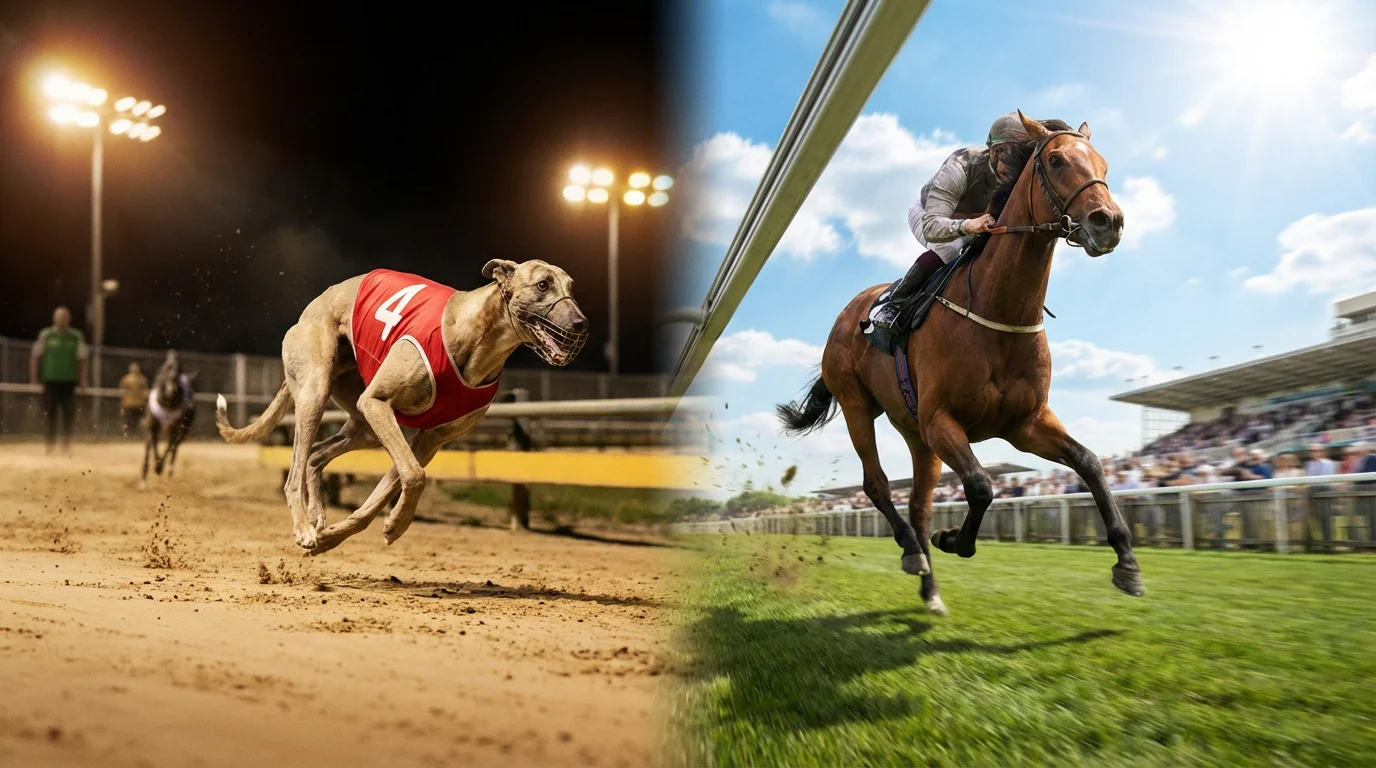
If you bet on horse racing, you already understand more about greyhound betting than you think. The core mechanics are identical: study the form, assess the draw, evaluate the conditions, and back your opinion at the best available price. The skills transfer. What doesn’t transfer automatically is the context — the field sizes, the race frequency, the odds dynamics, and the way form should be interpreted in a sport where six dogs run thirty seconds over sand instead of twelve horses running two minutes over turf.
This guide is for horse racing punters who want to add greyhound racing to their repertoire without starting from scratch. The knowledge you have is valuable; it just needs adjusting for a faster, smaller, more compact version of the same analytical challenge.
Smaller Fields, Different Dynamics
The most fundamental difference is field size. A standard UK greyhound race features six runners. No more, no less. Compare that to horse racing, where fields range from four to forty depending on the race type, and the implications are immediate.
Six runners means fewer variables. In a twelve-runner handicap, the number of possible finishing combinations is enormous, and isolating the winner requires eliminating ten rivals. In a six-dog greyhound race, you’re working with a much tighter set of possibilities. If you can confidently rule out two or three dogs on form, you’re left with a manageable shortlist of genuine contenders. This makes forecast and tricast betting far more viable than in horse racing — the permutations are dramatically smaller, and the dividends still reward precision.
Six runners also means the market is tighter. There’s less room for a rank outsider to slip through unnoticed. In horse racing, a 25/1 shot can lurk in a large field and produce a surprise result. In a six-dog race, every runner is visible, every form line is scrutinised, and genuine shocks are rarer. This doesn’t mean greyhound racing is predictable — first-bend incidents and trap draw mismatches ensure plenty of upsets — but the upsets tend to come from race dynamics rather than from obscure runners whose form was simply overlooked.
Race frequency is the other major shift. A typical horse racing meeting runs eight to ten races over four or five hours. A greyhound meeting runs twelve to fourteen races over three hours, with races every ten to fifteen minutes. The pace is relentless. You have less time between races to study the next card, which puts a premium on preparation. Doing your form work before the meeting starts, rather than between races, is the approach that experienced greyhound punters adopt — and it’s one horse racing punters should import immediately.
Form Analysis Differences
Horse racing form analysis centres on pedigree, going preference, jockey bookings, trainer patterns, weight carried, and course form. Greyhound form analysis shares some of these elements but replaces others entirely.
There is no jockey. The greyhound is both athlete and decision-maker. Its running style is fixed by instinct and training rather than by a rider’s tactical choices. This removes one variable but adds another: you can’t look at a jockey switch as a positive or negative signal. Instead, you’re reading the dog’s own tendencies — does it rail or run wide, does it lead or close — from its race history.
Going preferences exist but operate differently. All UK greyhound racing takes place on sand, and the surface varies primarily with moisture content rather than the ground descriptions used in horse racing (good, soft, heavy). A wet track slows greyhound times in much the same way soft ground slows horses, but the gradations are less formally classified. You won’t see an official going description on the greyhound racecard — you need to check the weather and the early race times to gauge the surface conditions yourself.
Trap draw replaces the starting stall draw, and it matters more. In horse racing, the draw advantage varies by course and distance, and over longer trips its effect diminishes. In greyhound racing, the trap draw influences the race at the first bend — which arrives within four seconds — and its impact persists on every subsequent bend. Inside traps have a measurable statistical advantage across UK racing, and that advantage is more consistent and more significant than any draw bias in horse racing.
Grading replaces race class. Where horse racing uses official ratings and class descriptions (Class 1 through Class 7, Group races, handicaps), greyhound racing uses a track-specific grading system from Open class down to D grade. Understanding the grade and any recent grade changes is the equivalent of tracking a horse’s official rating trajectory — a class drop signals easier competition, a step up signals a tougher test.
Odds and Markets Compared
Greyhound odds operate on the same principles as horse racing odds — fractional or decimal prices reflecting implied probability — but the market structure differs in ways that affect your betting approach.
Greyhound markets are thinner. The total amount bet on a single greyhound race is a fraction of what’s wagered on a competitive horse race. This means starting prices are more volatile: a small amount of money can move the market significantly. Prices drift more often and more dramatically in greyhound racing than in horse racing, which is why best odds guaranteed (BOG) is even more important for greyhound punters than for horse racing punters. If your bookmaker offers BOG on horse racing but not on greyhounds, that’s a gap worth closing.
The overround — the bookmaker’s built-in margin — is often higher on greyhound racing than on horse racing. A competitive horse racing handicap might carry an overround of 110–115%. A six-runner greyhound race might carry 115–120%. This higher margin means the odds are slightly less generous in absolute terms, which puts more emphasis on finding value rather than simply backing likely winners.
The range of markets is similar. Win, place, each-way, forecast, tricast, and accumulators are all available on greyhound racing, just as they are on horses. The key difference is in each-way terms: greyhound racing pays only two places (first and second) at 1/4 odds in a six-runner field, while horse racing typically pays three or four places depending on field size. This makes each-way greyhound betting more selective — the threshold for E/W value is higher, and win-only bets are often the smarter play at shorter prices.
Crossover Strategies
Several horse racing strategies transfer directly to greyhound betting with minimal modification.
Track specialisation works in both sports. Just as some horse racing punters focus on a handful of courses they know intimately, greyhound punters benefit from specialising at one or two tracks. Learning the trap biases, the grading patterns, and the trainer tendencies at a specific circuit produces better selections than spreading your attention across every track in the country.
Class analysis crosses over cleanly. Backing class drops and opposing class rises is a profitable approach in both horse racing and greyhound racing. A dog dropping from A3 to A5 — facing easier competition after a spell at a higher grade — is the greyhound equivalent of a horse dropping in class after running well at a higher level. The market often undervalues these dogs, just as it does in horse racing.
Pace analysis translates directly. Identifying the likely leader of a horse race and assessing whether the pace will be genuine or slow is a core racing skill. In greyhound racing, the same logic applies: identifying which dog will lead at the first bend and whether that dog can sustain its effort through the entire trip. The difference is that greyhound pace assessment is based on sectional times and trap draw rather than jockey tactics and race pace predictions.
Discipline is universal. Bankroll management, staking plans, record keeping, and emotional control work identically in both sports. If you already practise disciplined betting on horse racing, bring those habits with you to the dogs. They’ll serve you equally well.
One Track Mind, Two Sports
Greyhound racing rewards the same analytical mindset that horse racing does — patience, study, and the willingness to back your judgement when the form supports it. The adjustments are mostly about scale and speed: smaller fields, shorter races, faster turnover, more compact data. The underlying discipline is identical.
The easiest path in is to pick a track, study a week’s worth of form, place a few small bets, and watch the races. Within a month you’ll have a feel for how greyhound form reads differently from horse racing form — and within a season, you’ll wonder why you didn’t start sooner.