

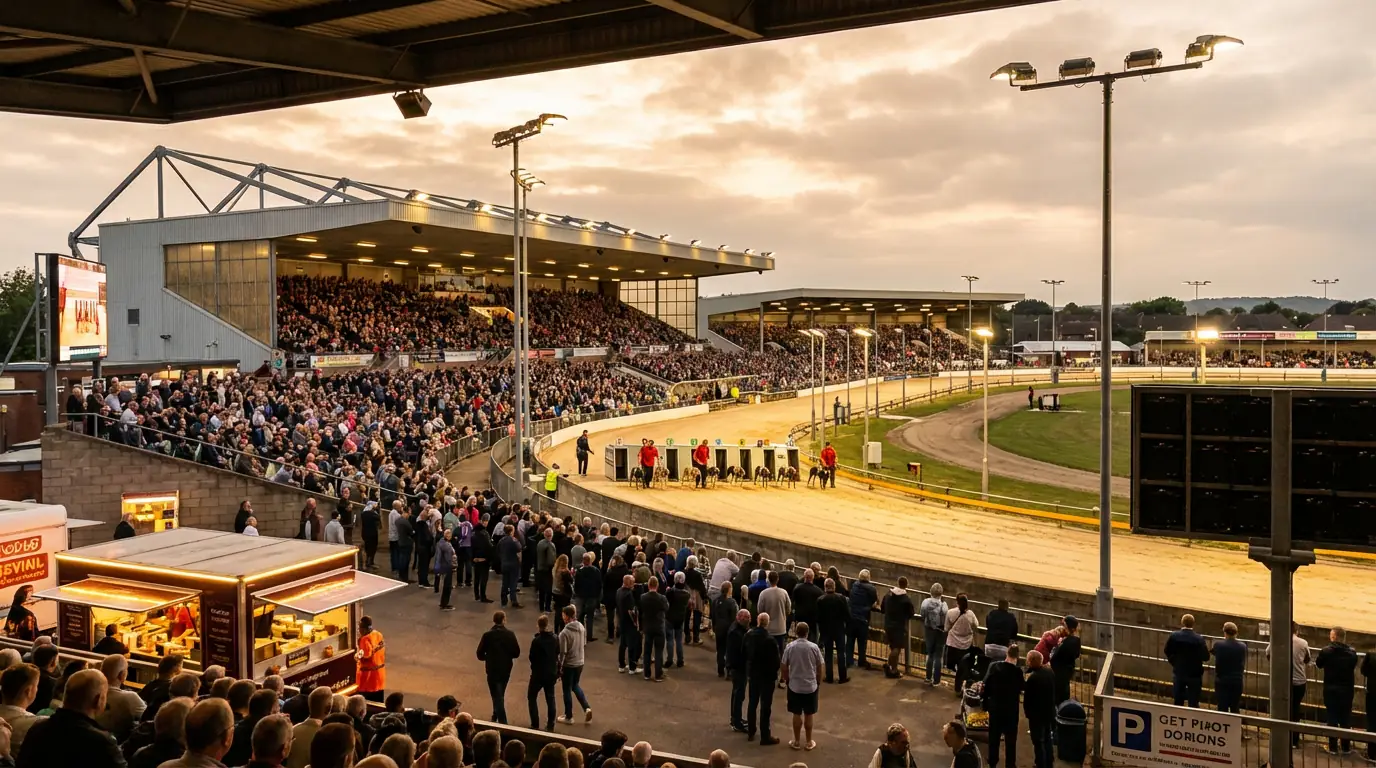
The Biggest Night in Dog Racing
The English Greyhound Derby is to dog racing what the Epsom Derby is to the flat — the one race that defines a generation. Every year, the best young greyhounds in Britain and Ireland are funnelled through a multi-round competition that lasts several weeks, testing speed, consistency, and the ability to reproduce top form under mounting pressure. The prize money is the largest in UK greyhound racing, the media coverage is the widest, and the betting market is the deepest. If there is one greyhound race that casual punters have heard of, it’s this one.
For bettors, the Derby represents the most sustained and complex betting opportunity in the greyhound calendar. The ante post markets open months in advance, the heats reshape the picture every round, and the final itself concentrates the form of the entire competition into a single thirty-second race that carries more weight, more money, and more scrutiny than any other event in the sport.
Find more race guides at greyhoundracingbettinguk.
History and Format
The English Greyhound Derby has been running since 1927, making it one of the oldest continuously contested greyhound races in the world. It has been held at a succession of English venues over the decades, including White City (1927–1984), Wimbledon (1985–2016), Towcester (2017–2018, 2021–present), and briefly Nottingham (2019–2020). The event has occasionally been disrupted by venue closures — the loss of Wimbledon Stadium in 2017 forced a relocation — but the competition itself has endured as the pinnacle of the sport.
The format follows a knockout structure spread across several weeks. A large entry — typically over a hundred greyhounds — is whittled down through successive rounds of heats until six finalists remain. The race is run over approximately 500m (the exact distance depends on the host track’s configuration), and each heat features six runners in the standard greyhound racing format. The competition usually begins in late spring, with the final held in early to mid summer.
Entry is open to greyhounds that meet the age and registration requirements set by the GBGB. Irish-trained dogs have a strong historical presence in the Derby, and the cross-border competition between British and Irish kennels is a significant part of the event’s appeal. Trainers target the Derby specifically, timing their greyhounds’ preparation to peak during the competition period.
The prize money for the winner of the Derby final is £175,000 (as of the 2025 edition), with additional prize money distributed to the placed dogs and heat winners. This makes it by far the richest race on the UK greyhound calendar and one that every major kennel aspires to win at least once.
How the Heats Work
The multi-round heat structure is what makes the Derby unique — and what makes betting on it so layered. The first round of heats divides the full entry into groups of six, with each heat producing qualifiers for the next round. The exact number of qualifiers per heat varies (typically the first two finishers advance, though the format can differ), and the draw for each round is conducted separately.
Each round provides new information. A dog that won its first-round heat comfortably might face a dramatically tougher assignment in the second round if the draw places it alongside other heat winners. The trap draw is redrawn for each round, which means a dog that benefited from trap 1 in round one might find itself in trap 6 in round two. Adaptability — the ability to perform from different draws against varying opposition — becomes a critical quality as the competition progresses.
For bettors, the heats offer some of the richest information in the entire greyhound calendar. You can watch every heat, time every run, note every piece of trouble in running, and build a detailed picture of which dogs are improving through the rounds and which are flat-lining or struggling. The quarter-finals and semi-finals, in particular, are where the quality concentrates: the remaining dogs have all won or placed well through multiple rounds, and the form from these later heats is the most reliable predictor of the final.
The semi-finals are the critical juncture. Six dogs make the final from two semi-final heats (three qualifiers per heat, typically). The semi-final draw can be decisive — a dog that draws favourably in a weaker semi-final faces an easier path to the final than one drawn in a stronger heat. Bookmakers adjust their ante post odds significantly after the semi-final draw is announced, and the market movement in the hours between the draw and the semi-final races is one of the most informative betting signals of the year.
Ante Post Betting Strategy
The Derby is the premier ante post betting event in greyhound racing, and the principles that apply to ante post betting generally apply here with particular force. Early prices are the most generous. Risk is highest in the early rounds. The market corrects as information accumulates.
The optimal strategy depends on when you enter the market. Backing a dog before the first round of heats means accepting maximum uncertainty: you don’t know the draw, you haven’t seen the dog against Derby-class opposition, and the risk of withdrawal through injury or poor form is at its peak. The prices reflect this — 25/1, 33/1, or longer odds on speculative fancies are common in the early market. If one of these long shots makes the final and wins, the return is exceptional. But the attrition rate through the rounds means most early ante post bets will lose.
Entering the market after the first or second round of heats provides a better information base at the cost of shorter odds. You’ve seen how the dog handles the Derby track, how it copes with a fresh draw, and how its times compare against the other surviving runners. Dogs that have progressed impressively might have shortened from 20/1 to 8/1, but if your analysis suggests they’re still overpriced relative to their actual ability, the value is still there — just less dramatic than the pre-heats number.
The post-semi-final window is the final opportunity for ante post value. By this point, the six finalists are known, the draw is set, and the market is relatively efficient. Prices on the favourite might be 2/1 or 5/2, with the rank outsider of the six at 10/1 or 12/1. There’s less scope for a massive overlay, but if you’ve followed the competition closely and have a strong view on a specific dog’s ability to handle the final draw and opposition, there can still be value in the final-day market — particularly on the second and third favourites, where the public money tends to concentrate on the top-priced dog.
Past Winners and Trends
The Derby has a rich history of producing memorable winners, and certain trends recur often enough to be worth noting — though none so reliably that they constitute a betting system.
Irish-trained dogs have an outstanding record in the event. Irish greyhound racing operates at a high standard, and the best Irish trainers target the English Derby specifically, often sending their top dogs across the water with detailed preparation plans. In recent years, Irish-trained runners have made up a significant proportion of the finalists — the 2024 winner De Lahdedah was the third consecutive Irish-trained champion, and the winner has frequently come from an Irish kennel. This isn’t a guarantee, but it’s a pattern that warrants attention when assessing the ante post market.
Early pace has historically been a strong predictor in Derby finals. The pressure of the occasion, the quality of the opposition, and the importance of the first bend all combine to make the Derby final a race where the dog that leads at the first bend wins more often than the closing percentage suggests. This is partly because the final features six dogs that have all proved their quality over multiple rounds — there are no weak links for a closer to pick off, and the overall pace tends to be high enough that leaders don’t tire as much as they might in a regular graded race.
Consistency through the rounds is another indicator. Dogs that win their heats progressively — improving their time or their margin of victory in each round — tend to be peaking at the right moment. Dogs that scrape through early rounds and only find form in the later heats are riskier propositions: they may have been flattered by easier draws or weaker opposition, and the final presents no such shelter.
The Night of the Final
Derby final night is the pinnacle of the UK greyhound racing year. The atmosphere at the host venue is unlike any regular meeting, the televised coverage brings the sport to a wider audience, and the betting market is at its most liquid. For punters, the final is both the simplest and the most pressured race of the year to bet on: six dogs, one race, one result — but with a full season’s worth of anticipation and analysis behind every selection.
The draw for the final, determined by the semi-final finishing positions, is critical. Assess each dog’s running style against its trap position. A front-running railer in trap 1 is the classic Derby profile — and the one the market typically favours. A closer drawn wide faces the longest path to victory. Between those extremes, the value often sits with dogs whose style suits their draw but whose profile is less obvious than the market leader’s.
Also read our ante post greyhound betting.
Stake within your means. The temptation to go large on the Derby final is real — it feels like the culmination of weeks of following the competition, and the urge to back your conviction with a significant bet is powerful. Resist the impulse to exceed your normal staking. The Derby final is still a six-runner greyhound race, and any of the six finalists is capable of winning. That’s what makes it the greatest race in the sport — and what makes it a race to enjoy as much as to profit from.
