
Every Dog Runs Its Own Race
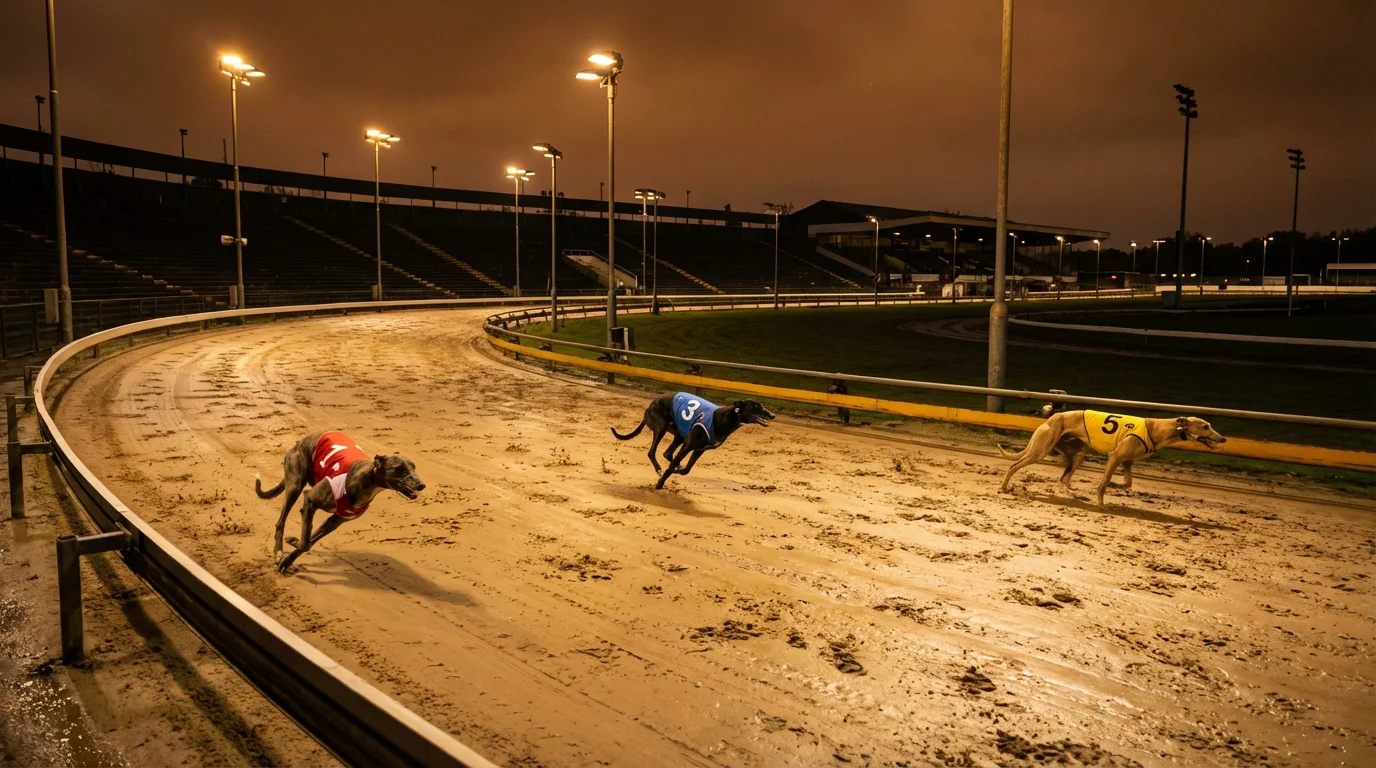
Every greyhound has a preferred way of running a race, and that preference is one of the most important factors on the racecard — even though it rarely appears as a single clean data point. Some dogs hug the rail from trap to line. Others sweep wide on every bend, racing around the outside of the pack. Some break fast and try to lead from the first stride; others settle at the back and close late. These aren’t random tendencies. They’re consistent behavioural patterns, often visible from a dog’s very first races, and they determine how a greyhound interacts with the track, the trap draw, and every other dog in the field.
Understanding running styles lets you read races before they happen. When you know which dogs rail, which run wide, and which need the pace to collapse before they can strike, you can visualise how the first bend will unfold, where the trouble is likely to occur, and which dogs stand to benefit from the likely race shape. That’s a level of analysis that goes beyond raw times and finishing positions, and it’s one of the areas where attentive punters gain a genuine edge.
Get more form guides at greyhoundracingbettinguk.
Railers
A railer is a greyhound that naturally gravitates to the inside rail and runs the shortest possible route around the track. From the moment it leaves the traps, a railer aims to secure the rail position and hold it through every bend. It corners tight, stays close to the inside line, and saves ground on every turn. In a sport where races are decided by fractions, that saved ground is a tangible physical advantage.
Railers are the dogs most obviously affected by trap draw. A confirmed railer drawn in trap 1 or trap 2 has a short, clean path to the rail — it can break from the boxes and be on its preferred line within two or three strides. The same dog drawn in trap 5 or 6 faces a problem: it needs to cross the path of four or five other dogs to reach the inside rail, which costs time, energy, and often involves bumping or being checked. A railer drawn wide is a dog fighting its own instincts against the geometry of the start.
Racing managers at UK tracks know this, and in graded races they typically seed confirmed railers into the inside traps. Trap 1 and trap 2 in a graded race will almost always contain dogs identified as railers or dogs that run best on the inside. This seeding mitigates the trap draw disadvantage, but it doesn’t eliminate it entirely — especially when a railer meets another railer drawn alongside it, and both try to claim the same strip of rail on the first bend.
For punters, the key railer question is whether the dog’s draw matches its style. A railer drawn in trap 1 with no other strong railers in the field is in an ideal position — it should reach the rail unchallenged and run its race unimpeded. A railer drawn in trap 3 alongside another railer in trap 1 may face a first-bend battle for the inside line that costs both dogs ground and opens the door for dogs running wider. The racecard abbreviations and comments sections often indicate running style (look for “rls” for rails, or comments noting the dog’s preference for the inside), and watching previous races confirms the pattern.
The most reliable railers are the ones that hold their line even under pressure. A dog that can be bumped off the rail by a rival and still recover its inside position is a more dependable prospect than one that drifts wide when challenged. Consistency of rail position across multiple races is the indicator — if a dog rails in eight out of ten starts, that’s a genuine style trait. If it rails in five and runs mid-track in the others, the style is less fixed and less predictable.
Wide Runners and Middle Seeds
Wide runners are the mirror image of railers. These dogs naturally move to the outside of the track, taking a wider path through the bends and racing around the field rather than through it. They cover more ground per lap — that’s the trade-off — but they avoid the congestion and interference that frequently occurs on the inside rail, especially through the first and second bends.
A wide runner drawn in trap 5 or 6 is in its element. It breaks from the outside boxes, has a clear run to its preferred racing line, and doesn’t need to cross the path of any other dog. The extra ground it covers by running wide is the price it pays for a trouble-free trip. At tracks where the bends are tight and the inside line is congested, that trade-off can be favourable — a clean, wide run often produces a faster time than a disrupted, stop-start rail run. At wider tracks with more room for all runners, the wide-running style offers less of an advantage because there’s less inside congestion to avoid.
Middle seeds — dogs that run between the rail and the wide line — are harder to categorise but no less important. These are greyhounds that don’t commit fully to either the inside or outside path, instead tracking a middle course through the bends. Some middle-seed dogs are genuinely versatile, adapting their position based on the race around them. Others have simply never established a consistent preference and end up in mid-track by default rather than by design.
For punters, middle seeds are the least predictable runners from a positional standpoint. Their racing line depends on what the dogs around them do, which makes it harder to visualise the race in advance. A middle-seed dog drawn in trap 3 or 4 — the typical seeding positions for this style — will find space if the railers go inside and the wides go outside, but can get squeezed if the dogs on either side converge towards the middle on the first bend. This makes middle-seed dogs higher-variance selections: when the race shapes well for them, they can win comfortably; when it doesn’t, they can be caught in traffic with nowhere to go.
The racecard will often indicate “mid” or “msd” for middle-seed dogs. Cross-referencing this with recent race comments — “ran in mid-division,” “held mid-track through bends” — confirms the pattern. If the comments are inconsistent — sometimes inside, sometimes wide, sometimes mid — the dog is a positional wild card, which may suit forecast and tricast punters looking for volatility in the frame.
Front-Runners vs Closers
The lateral dimension — rail, middle, or wide — is only half the picture. The other axis is pace: does the dog lead or follow? Front-runners and closers represent fundamentally different approaches to winning a race, and each comes with its own set of strengths and vulnerabilities.
Front-runners are dogs that break quickly from the traps, lead the field to the first bend, and try to hold that lead all the way to the finish. They rely on early speed and the psychological and physical advantage of clear air — once in front, they set the pace and force every other dog to come around them or through them. At pace-favouring tracks with tight bends, front-runners are extremely effective because once they establish the lead at the first bend, the geometry of the circuit protects them. The dogs behind have to cover more ground to overtake, and the tight bends make it difficult to challenge without losing momentum.
The weakness of front-runners is predictable: they can fade. A dog that blazes to the front in the first three seconds burns energy at a rate that may not be sustainable over the full trip. If it doesn’t establish a decisive lead early, stronger dogs with more stamina can close the gap in the final straight. Sprint races are where front-runners are most dominant — there simply isn’t enough race for closers to catch them. Over standard and staying distances, the front-runner’s advantage narrows as the trip gets longer.
Closers — sometimes called finishers or come-from-behind dogs — run their race in reverse order. They break without urgency, settle toward the back of the field, and use the final bend and straight to produce a burst of finishing speed that carries them past tiring leaders. The best closers have exceptional run-home sectionals: their final split is often the fastest in the race, even when their overall time is unremarkable. They depend on the race being run at a genuine pace in front of them, because a slow early pace means the leaders have more energy to hold on.
Closers are harder to back with confidence because their success depends on circumstances outside their control. If the pace collapses — if the leaders take it easy through the first two bends — the closer never gets the tiring runners it needs to pick off. If two front-runners clash on the first bend and take each other out of contention, the closer benefits enormously from the disruption without doing anything different. This race-dependent quality makes closers higher-variance selections. They win when the race shapes in their favour and fail when it doesn’t, regardless of their own ability.
The form book reveals running style through sectional data. A dog with consistently fast first-bend splits is a front-runner. A dog with mediocre early splits but elite finishing splits is a closer. Dogs that sit midfield early and produce a steady effort throughout are pace-sustainers — they rarely produce dramatic closing runs but also rarely fade badly.
Style Meets Draw
Running style and trap draw are inseparable. A confirmed railer drawn on the outside is a dog at war with its own instincts. A wide runner drawn inside is likely to cause interference as it crosses the field to reach its preferred line. A front-runner drawn in a field with two other front-runners faces a pace battle that may exhaust all three. A closer drawn in a field where nobody wants to lead will find nobody tiring in front of it.
Also check our greyhound racecard guide.
Before you assess a dog’s speed, form, or class, ask how it runs and whether today’s draw lets it run that way. If the style matches the draw, you’re looking at a dog set up to produce its best. If there’s a mismatch, factor in the cost — slower sectionals, wider runs, more energy spent navigating to its preferred position. Style meets draw at the first bend, and what happens there sets the terms for the rest of the race.
