
The Forecast That Matters
The forecast you check before a night at the dogs shouldn’t just be the odds. Weather conditions change how greyhound races are run in ways that most casual punters underestimate. Rain softens the sand, slowing times and altering grip. Heat bakes the surface hard, favouring different running styles. Wind — particularly at exposed circuits — can add seconds to finishing times and disrupt dogs running into a headwind on the back straight. These aren’t marginal effects: they change results.
UK greyhound tracks are outdoor sand surfaces, and sand reacts to weather with more sensitivity than turf or all-weather horse racing surfaces. The moisture content of the track, the ambient temperature, and the wind conditions all influence how fast dogs can run, how well they grip on the bends, and which running styles are rewarded or penalised. Factoring weather into your assessment won’t turn a bad selection into a winner, but ignoring it regularly turns good selections into losers.
Get more race analysis at greyhoundracingbettinguk.
Wet Track Racing
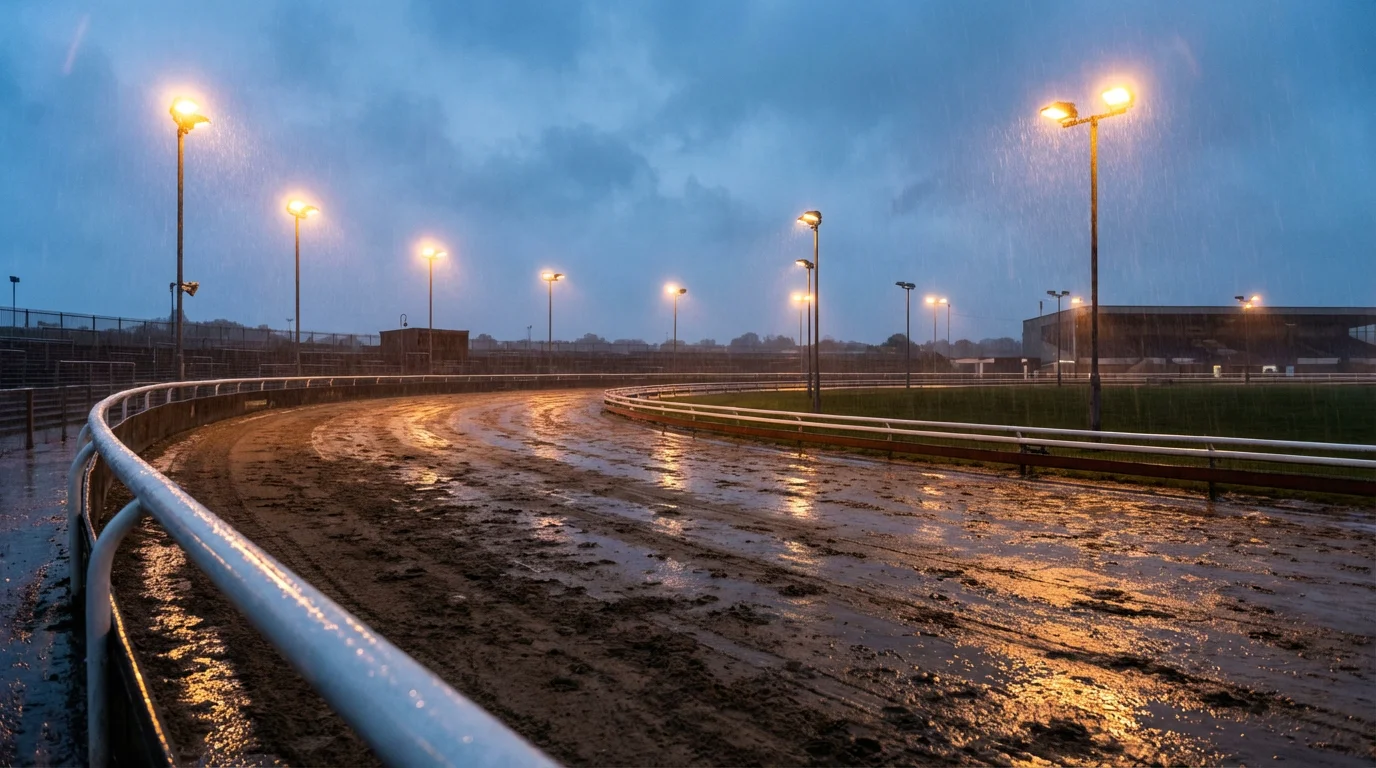
Rain is the single most impactful weather variable in greyhound racing. When it rains on a sand track, the surface absorbs moisture and becomes heavier. The sand packs down, grip increases on the straights but can become unpredictable on the bends, and overall times slow — sometimes significantly. A track that produces 29.50-second 480m times in dry conditions might see those times drift to 30.00 or above after sustained rainfall.
The effect is not uniform across all dogs. Greyhounds that rely on explosive acceleration — the trap-speed merchants who blaze the first bend — often struggle more on wet surfaces because the heavier sand absorbs some of that initial burst. The fractions of a second lost from the traps to the first timing point can be enough to change who leads into the bend, which reshuffles the entire race. Dogs that run prominently rather than leading — sitting second or third through the early stages and picking up the pieces — may benefit, because the pace dogs ahead of them are working harder against the surface.
Stamina becomes more valuable in the wet. Running through heavy sand requires more physical effort per stride, which means dogs that typically fade in the final straight under normal conditions may fade even earlier. Conversely, dogs with stamina reserves — the strong finishers who close well over the last hundred metres — gain a relative advantage because the tiring effect of the surface hits their rivals harder. This is particularly noticeable at standard and staying distances, where the accumulated effort over four or more bends on a wet surface takes a measurable toll.
Certain dogs simply handle wet conditions better than others, and this preference isn’t always obvious from the racecard. Some greyhounds have a physical build or running action that copes well with reduced grip — perhaps they carry more weight, or they have a naturally lower centre of gravity that keeps them balanced on damp bends. Others fall apart when the surface changes, losing their rhythm and their confidence. If you track results across different conditions over time, you’ll start to notice which dogs at your preferred tracks are “wet-track specialists” whose form improves markedly when it rains.
One practical tip: check the recent race times on the card before betting. If the early races on a meeting are running significantly slower than the standard times for that distance and grade, the track is riding heavy. Adjust your expectations for the later races accordingly — and look for dogs whose form on slow tracks stands up better than their form on fast ones.
Dry and Hard Conditions
Prolonged dry weather produces the opposite surface characteristics. The sand dries out, loosens on top, and becomes faster. Times come down, sometimes dramatically. A track that ran slow all week after rain can produce times two or three tenths of a second quicker after a couple of dry, warm days. For greyhound racing, where most races are decided by less than a length, a few tenths of a second is a substantial change in the competitive balance.
Fast, dry tracks reward speed dogs. The greyhounds with the fastest trap breaks and the highest cruising speed thrive when the surface offers minimal resistance. Front-runners are harder to catch because the ground beneath them isn’t sapping their effort. Closers have a harder time making up ground because the leaders aren’t tiring as quickly. The gap between the pace dog and the chaser narrows more slowly on a fast surface, which means the front-runner has a better chance of holding on.
Very dry conditions can create problems too. When sand moisture drops too low, the surface becomes loose and dusty. Grip on the bends can deteriorate, particularly for dogs that take the tightest inside line. A dog that relies on cornering tightly at the rail may struggle if the inside strip has dried out and lost its binding, while a wider-running dog on slightly better ground might gain an unusual advantage. This is rare — track staff water the surface to maintain it within optimal parameters — but during heatwaves or extended dry spells, it’s a factor worth noting.
Summer evening meetings in the UK often run on the fastest surfaces of the year. The combination of daytime warmth, low humidity, and track preparation produces conditions where times are at their quickest. For punters, this means that form recorded in summer may not translate directly to autumn or winter conditions when the track is wetter and slower. A dog that posts a fast time on a July evening isn’t necessarily that quick — the surface may have done much of the work.
Wind and Exposed Circuits
Wind is the least discussed and most underestimated weather factor in greyhound racing. Unlike rain, which affects the surface itself, wind affects the dogs directly — and not all parts of the track equally.
Most UK greyhound tracks are oval circuits with two straights and two sets of bends. A strong wind blowing along the length of the track creates a headwind on one straight and a tailwind on the other. Dogs running into the headwind on the back straight expend more energy covering the same distance, arriving at the next bend slightly more fatigued than they would in still conditions. On the home straight, a tailwind can artificially inflate finishing speed — the dog appears to finish strongly, but the wind is providing assistance rather than the dog producing a genuine acceleration.
Exposed circuits — tracks without significant surrounding buildings, trees, or stands to break the wind — are most affected. Open-air venues in flatter parts of the country can experience significant wind disruption on blustery evenings, while more sheltered stadium environments in urban areas are largely protected. Knowing which tracks in your regular rotation are wind-exposed and which are sheltered is useful contextual knowledge.
Crosswinds present a different challenge. A strong crosswind on a bend can push dogs off their racing line, causing them to run wide or drift inward. This disrupts running patterns — a confirmed railer might be blown off the rail, while a wide runner might be pushed into the path of inside dogs. The unpredictability that crosswinds introduce increases the variance of results, making strong form selections less reliable and producing more unexpected outcomes.
The practical application is straightforward: on windy evenings, reduce your confidence in any single selection and consider whether the conditions favour a particular running style or trap position. A headwind into the first bend slows front-runners and makes it slightly harder for inside traps to establish their usual advantage. A tailwind into the first bend has the opposite effect, boosting the pace and amplifying the trap draw advantage. These are small adjustments, but they’re the kind of detail that separates thorough analysis from surface-level form reading.
Check the Forecast Before the Racecard
Check the forecast before the racecard. That sequence matters. If you study the form first and then discover the track is waterlogged, you’ve wasted twenty minutes analysing times that were recorded in conditions that no longer apply. If you know before you start that tonight’s meeting is running on heavy sand after afternoon rain, you can weight your analysis toward dogs that handle wet conditions, deprioritise pure speed dogs, and adjust your expectations on times and running patterns from the outset.
Also read our greyhound sectional times.
Weather doesn’t override form — a good dog on a bad surface is still usually a good dog. But it tilts the margins, and greyhound racing is a sport of margins. A couple of tenths of a second on a wet track, a headwind slowing the pace into the first bend, a dry surface that brings out the best in a front-runner — these details sit between the lines of the racecard and reward the punters who look for them.
