

The Structure Behind the Racecard
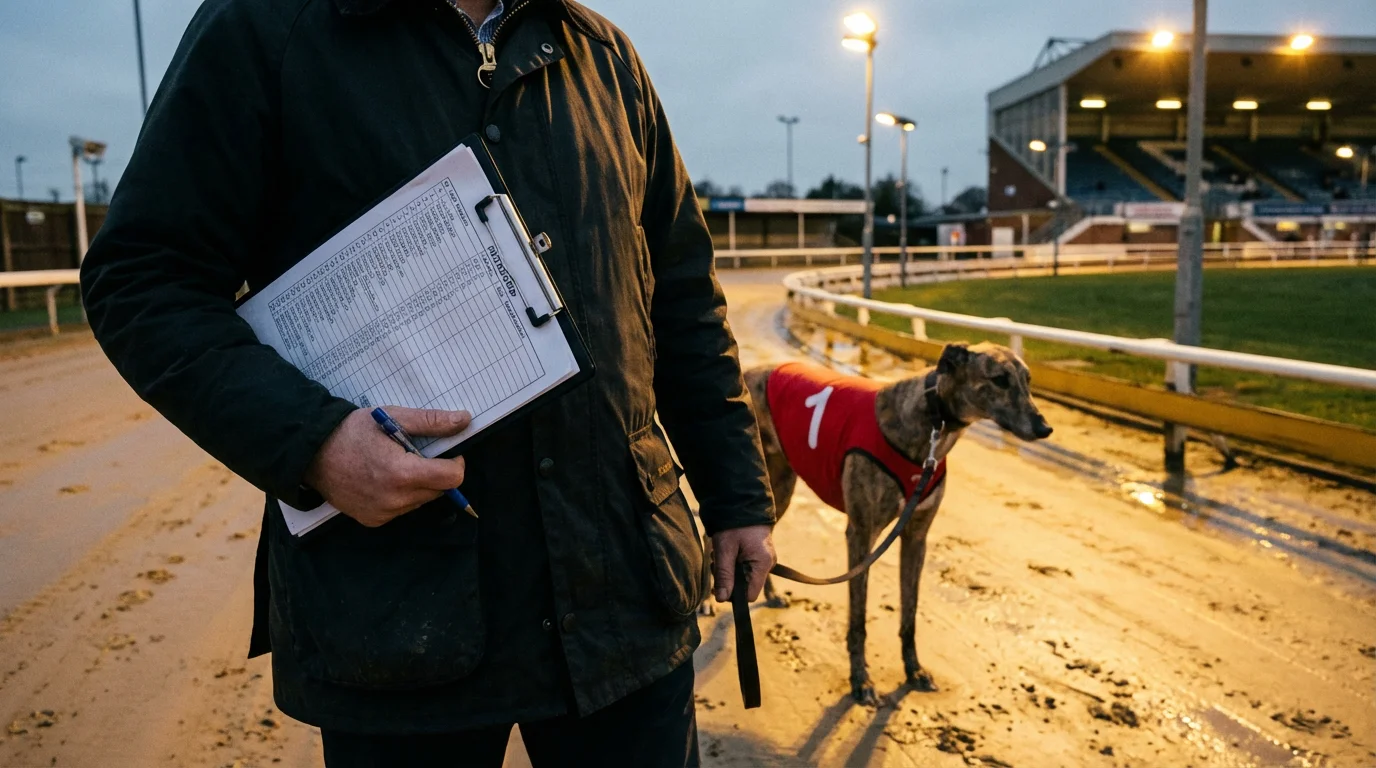
Grades exist so that every dog races against dogs of similar ability. That’s the principle, and it’s a good one — without a grading system, the fastest open-class greyhounds would share racecards with dogs still finding their feet, and competitive racing would collapse. The UK grading structure, managed at track level under GBGB regulations, classifies every racing greyhound by ability and ensures that each race is genuinely contested rather than a procession.
For punters, understanding grades is about more than knowing the rules. The grading system creates the context in which form should be read. A dog’s recent results mean very different things depending on the grade it was competing in: winning an A6 is not the same as winning an A2, and losing a B3 is not the same as losing an open race. Without grade awareness, you’re reading form lines in a vacuum — seeing numbers without understanding the competition those numbers were achieved against.
Find more race guides at greyhoundracingbettinguk.
The UK Grading Ladder: Open to D
The UK grading ladder runs from Open class at the top — the elite level, featuring the best greyhounds in the country — through a series of letter-and-number grades down to D grade at the bottom. The exact number of subdivisions varies by track, because each licensed circuit operates its own grading system within the framework set by the GBGB (Timeform grading guide). A large track with hundreds of active dogs on its books might use grades from A1 through A11, plus B, C, and D grades. A smaller track might operate a simpler structure with fewer A-grade subdivisions.
Open class sits above all graded racing. Open races are not restricted by time or grade — any dog can be entered, and the fields typically feature the fastest greyhounds at the track. Feature races, televised events, and major competitions are usually run at open level. For punters, open races represent the highest quality of racing and often the most competitive markets, with form analysis requiring greater attention to detail because every dog in the field is capable of winning.
A grades are the main body of competitive racing at most tracks. The numbering typically runs from A1 (the highest graded level below open) down through A2, A3, A4 and so on, sometimes as far as A10 or A11 at tracks with large dog populations. The lower the number, the higher the quality. An A1 race is just below open class; an A8 race contains significantly slower dogs. The boundaries between A grades are determined by winning times over the standard distance at that track — a dog that runs a specific time window will be graded at the corresponding level.
B, C, and D grades sit below the A-grade structure. B grade typically covers dogs that are competitive but not quick enough for the lower A grades. C and D grades cater to the slowest dogs at the track — often young dogs still developing, older dogs declining, or dogs recovering their form after a break. Not every track uses all of these lower grades; some smaller circuits may combine them or use a simplified structure.
The key point is that each grade represents a specific ability band at that particular track. An A5 at Romford is not directly equivalent to an A5 at Nottingham, because the time-based thresholds are calibrated to each track’s individual circuit length, surface, and running characteristics. Grade is always relative to the track. A dog graded A3 at one track might find itself competing at A5 or A6 level if it transfers to a circuit with a faster dog population. This relativity is something that punters need to keep in mind when assessing form lines that span multiple tracks.
How Dogs Move Between Grades
Greyhound grades are not fixed. Dogs move up and down the ladder based on their performance, and the movement follows a set of rules that, once understood, make the form book considerably more informative.
The primary trigger for promotion is winning. A dog that wins a race at its current grade will typically be raised by one grade — sometimes two if the winning time was significantly faster than the standard for that grade. This is the racing manager’s mechanism for keeping competition balanced: a dog that’s too good for its current grade is moved up to face tougher opposition. Consecutive wins can push a dog up several grades in quick succession, which is why you’ll sometimes see a dog listed at A3 that was racing at A7 just a month earlier.
Demotion — dropping to a lower grade — happens when a dog’s recent times no longer justify its current classification. If a dog has run several races without competitive times, the racing manager may lower its grade to place it in a band more suited to its current form. This can happen after a poor run of results, after an injury layoff, or simply because a dog is ageing and slowing down. Demotion can also occur when a dog moves to a new track and its times at the new circuit fall into a lower grade band than it held at its previous track.
Time-based regrading is the other major factor. Many tracks review their grading periodically — weekly or fortnightly — and adjust dogs based on their recent calculated times rather than waiting for a specific trigger like a win. A dog whose times have improved over several runs may be promoted even without winning a race. Conversely, a dog whose times have deteriorated may be dropped a grade even if its finishing positions look respectable — because those positions were achieved against weaker fields.
For punters, grade movement is one of the most underrated pieces of information on the racecard. A dog that has just been promoted is stepping into tougher competition. Its recent form — possibly a string of wins — was achieved at a lower grade, and the question is whether that form translates against better opponents. A dog that has just been demoted, on the other hand, is dropping into easier competition. It may have been losing at its previous grade, but if those losses were narrow or against genuinely strong fields, the class drop could see it return to winning form immediately. This is where grade awareness becomes a betting edge.
What Grade Means for Betting
Grade context affects how accurately the market prices each runner, and this is where the betting value lies. The most common mistake punters make is looking at a dog’s recent results — two wins from its last three runs, say — and assuming it’s in strong form. What that assessment misses is whether those wins came at the same grade the dog is racing at today. Two wins at A7 followed by a promotion to A5 is a very different proposition from two wins at A5 followed by another run at A5.
Class drops are among the most reliable value indicators in greyhound racing. A dog dropping from A3 to A5 isn’t declining — it’s been handed easier competition. Perhaps it was narrowly beaten at A3, running good times but not quite quick enough to win against that calibre. At A5, those same times might be the fastest in the field. The market sometimes undervalues dogs on a losing run without adequately accounting for the grade of those losses. If a dog has been competitive at a higher grade, its drop in class is a signal to look more closely, not to dismiss it.
The reverse applies to recent promotions. A dog promoted after two consecutive wins at A7 will often attract significant money in its first run at A5 — punters see the winning streak and assume the form will continue. But the step up in quality is real. The A5 field will be faster, the competition for early position fiercer, and the times needed to win meaningfully quicker. Backing a newly promoted dog at short odds is one of the most common traps in greyhound betting. The winning run is priced in; the step up in grade often is not.
The grade of a dog’s opponents in previous runs also matters when comparing form across different dogs in the same race. Dog A might have finished third in an A3 last week. Dog B might have won an A7. On paper, Dog B looks the better form dog — but Dog A’s third at a much higher grade might represent a superior performance. Comparing results without grade context is like comparing exam scores without knowing the difficulty of the test.
Some punters maintain records of grade movements for their preferred tracks, noting which dogs have recently been promoted or demoted and tracking how they perform in their first run at the new level. Over time, this practice reveals patterns: certain trainers’ dogs handle promotions better than others, certain grade drops produce winners at a higher rate at specific tracks, and the market tends to over-bet recent winners and under-bet recent class drops with systematic regularity.
Grade Fluency
Grade isn’t quality — it’s context. A D-grade dog isn’t a bad greyhound; it’s a greyhound racing against other D-grade dogs. An A1 dog isn’t automatically a good bet; it’s a dog facing the toughest opposition at the track. The grade system exists to create competitive balance, but for punters, its real function is to provide a framework for interpreting everything else on the racecard.
Also read our open races vs graded races.
Learn the grading structure at the tracks you bet on. Watch how dogs perform in the run immediately after a grade change — that single data point is often the most revealing form indicator available. And when the market overvalues a winning streak without accounting for a promotion, or undervalues a losing streak without noting the demotion that follows, the grade-aware punter is the one collecting the value.
